 LadderCage
Ladder Cage Principle Explained
How Does A Ladder Cage Work
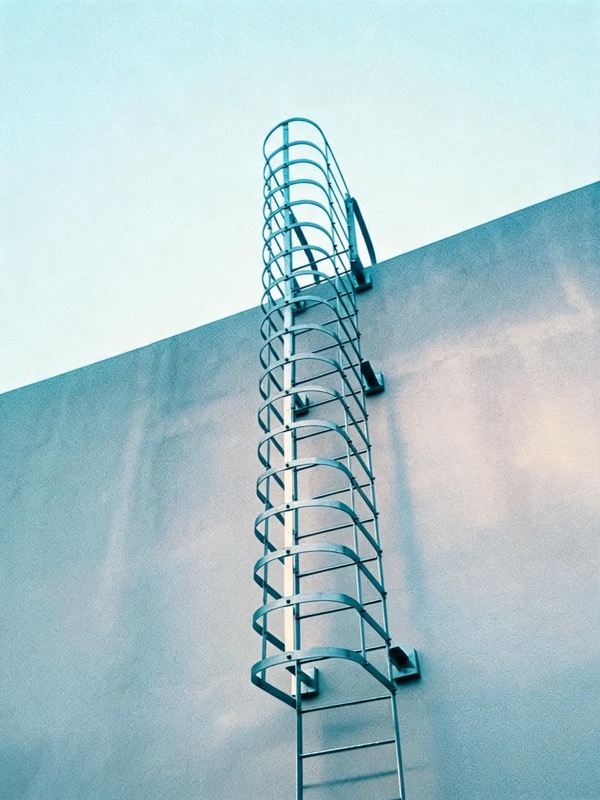
A ladder cage forms a tunnel around the climber, limiting fall range. Free compliance specs with every quote; DoC included.
Years Manufacturing
Export Countries
Projects Delivered
Quote Response
How the Tunnel Works
Ladder Cage Fall-Limit Mechanism Explained
A ladder cage creates a containment tunnel around the climber. If a foot slips, the climber stays inside the hoops instead of falling clear of the ladder — limiting fall range and reducing injury.
- Containment — hoops and straps enclose the climb path
- Limits range — the fall is contained, not arrested
- Not fall arrest — different mechanism from a personal fall-arrest system
What the Cage Is Made Of
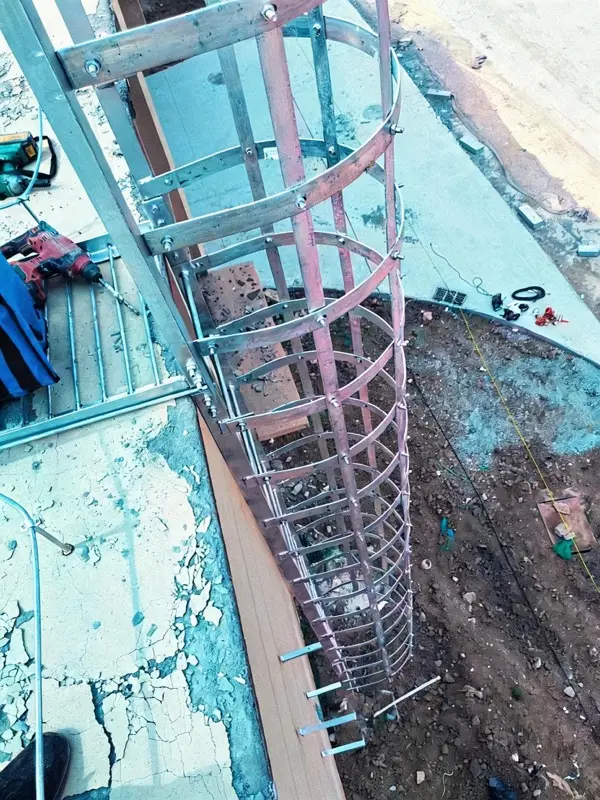
Ladder Cage Components
Rungs
Φ20 mm rungs at 280 mm spacing give a consistent, comfortable climb inside the cage.
Hoops & Straps
Φ700 mm hoops with vertical straps form the tunnel that contains and limits the fall range.
Flared Entry
The flared splay entry guides the climber smoothly into the cage tunnel from the platform.
Specifications
How Does A Ladder Cage Work — Specifications
The engineered parameters that make the tunnel effective and compliant.
Get My Free Specs| Specification | Value |
|---|---|
| Rung Diameter | Φ20 mm |
| Rung Spacing | 280 mm (≤300 mm) |
| Clear Width | 500 mm |
| Cage Diameter | Φ700 mm (hoops 40×5 @≤1500, straps 30×3) |
| Cage Start | 2.2 m above floor |
| Entrance | Flared / flared splay entry |
| Load Rating | 1.5 kN per rung |
| Finish | HDG 85–100 μm / SS304 optional |
| Standards | OSHA 1910.28 · EN ISO 14122-4 · BS 4211 |
Compliance & Free Specs
Compliance & Free Specs (OSHA / EN ISO 14122-4)
Compliance docs with every cage ladder — DoC included, plus free compliance specs with every quote.
- DoC — OSHA 1910.28 & EN ISO 14122-4
Declaration of Conformity included
- MTC 3.1 Material Certificate
EN 10204 3.1 for Q235B / SS304
- Free Compliance Specs
Engineer-reviewed with every quote
Free Compliance Specs
Compliance notes and drawings included with every quote.
24h Itemized Quote
Transparent, line-by-line pricing direct from the factory.
15–25 Day Lead Time
500+ projects delivered across 50+ export countries.
Get a Ladder Cage Quote
Get Free Compliance Specs & Quote
Specs and quote within 24 hours. Tell us your application, height and material — an engineer handles the rest.
- Free compliance specs
- 24h itemized quote
- DoC, MTC & structural calcs included
Cross-Section Through a Working Cage
What Each Element Does the Moment You Slip
Slice a cage ladder horizontally at any point above 2.2 m and the same picture appears: a climber inside a Φ700 mm steel ring, held on a predictable climbing line. Here is the role every element plays in that cross-section when things go wrong.
| Element | Section in the Slice | Job in a Slip Event |
|---|---|---|
| Cage barrel | Φ700 mm circle around the climber | Keeps body mass inside the climbing line |
| Hoops | 40×5 mm rings at 1500 mm centers | Resist radial impact and keep the ring round |
| Straps | 30×3 mm verticals between hoops | Stitch rings into a continuous wall for the torso |
| Rungs | Φ20 mm bar at 280 mm pitch, 1.5 kN rated | Set a rhythm that limits how far a foot can miss |
| Flared entry | Widened ring at the cage base | Delivers you into the tunnel without snagging |
| Standoff brackets | Wall or steel connections | Transfer side loads to the structure, keep toes clear of the wall |
Together these parts form passive containment — always on, no harness or training to engage. It is why cages remain the default for general industry access, and why the system boundaries of OSHA 1910.28 and EN ISO 14122-4 still start from this same cross-section.
Mechanism in Time Order
How a Ladder Cage Works: The Slip Event, Moment by Moment
The cross-section shows the parts standing ready. The mechanism only proves itself in sequence — from the instant a boot misses to the moment the climber is back on three points of contact. Follow the five moments below; each one names the member doing the work and the number that makes it sufficient. Nothing in the sequence requires the climber to wear, clip or activate anything, and that is the entire design philosophy.
| Moment | What Happens | Member Doing the Work | The Number That Matters |
|---|---|---|---|
| 1 — The miss | Booted foot searches for the rung and lands on air; balance tips rearward | The rung line below still holds the rhythm of the climb | 280 mm pitch — the next bar is one short step away |
| 2 — The grip loads | Hands take the full body mass on the stringers; the arms become the pivot | Side stringers and the rung-to-rail welds carry the transient | Welds inspected to ISO 5817 Level C before the ladder shipped |
| 3 — The rotation meets steel | Torso swings backward on an arc — into the strap wall, not into open air | 30×3 mm straps passing the load around the hoop circumference | Φ700 mm barrel — the arc ends inches from where it started |
| 4 — The ring holds its shape | The hoop resists the radial push without flattening into an oval | 40×5 mm hoops at their 1500 mm spacing, tied to the stringers | Ring stiffness is the difference between a wall and a suggestion |
| 5 — The recovery | Climber re-foots, re-establishes three points, continues or descends | The next Φ20 mm rung receiving the step down | 1.5 kN rating per rung — recovery never depends on luck |
Five moments, zero equipment donned — that is the mechanism working. And the honest footnote stands: the sequence contains no arrest, which is why the same climb above 24 ft on a new US install also carries an LSS or PFAS under OSHA 1910.28. Send your climb height and the free compliance specs state where your bay stands, within 24 hours.
Is This Mechanism Yours
Reader Decision Guide: Matching the Mechanism to Your Users and Rule
Understanding how a cage works tells you who it works for. The mechanism is passive containment — brilliant for routine maintenance climbs, insufficient where the rule demands arrest or the user needs protection the barrel cannot give. Three reader situations cover nearly everyone on this page.
Your users are trained maintainers
The mechanism fits: routine climbs, three points of contact understood, tools hoisted rather than carried. For this population on 3–10 m EN or AS climbs — or the US equivalent a cage covers — the passive barrel is the proportionate protection, and the $95 per metre HDG build with a 2.2 m cage start is the correct order.
Your users are occasional or escorted
Half-fit users stress every assumption in the sequence — grip strength at moment 2, recovery at moment 5. If contractors, visitors or multi-trade staff climb, invest beyond the minimum: the rest platform at $150–400 past 6 m, the gated walk-through exit, and a written induction at the base. The mechanism still works; you are covering the human moments.
Your rule or height demands arrest
Above 10 m under EN ISO 14122-4, or above 24 ft on a post-November 2018 US install, the mechanism has a legal ceiling — no barrel satisfies OSHA 1910.28 alone. Order the LSS or PFAS line for the arrest duty and let the cage do what it does best underneath: contain the routine slip on every ordinary climb.
User profile plus rule equals the order — send both through the form and the free compliance specs return the exact build, quoted within 24 hours.
Mechanism, Manufactured
What Each Feature Contributes to the Working Cage
Five features, one per moment of the slip sequence.
| Feature | Advantage | Your Outcome |
|---|---|---|
| Rhythm held at 280 mm | every rung where a climber expects it | moment 1 stays a stumble, never a search |
| Welds qualified to ISO 5817 Level C | the pivot at moment 2 is certified, not assumed | transient loads ride joints with a record |
| Strap wall at 30×3 mm, continuous | the arc at moment 3 lands on a wall, not a gap | containment works at every height above 2.2 m |
| Trial assembly before shipment | the whole mechanism bolted together at the factory | moments 1 to 5 arrive pre-proven in the crate |
| Free compliance specs with every quote | the mechanism mapped to your code and height | you buy the layer your rule requires — nothing less |
How Does A Ladder Cage Work — FAQ
Related Cage Ladder Pages
FAQ
Answers to common cage ladder questions
Cage Ladder Definition
What is a cage ladder and how it works
Does a Ladder Cage Prevent Falls?
Cage vs fall-arrest, the evidence
Cage Ladder Parts
Rungs, hoops, flared entries & fixings
Standards Hub
OSHA, EN ISO, BS, AS requirements
Get a Quote
24h itemized quote