 LadderCage
AS 1657:2018 Cage Ladders for Australia
Ladder Cage Requirements Australia
AS 1657 cage ladders for Australian projects; full height cages. Local compliance docs for AU buyers; DoC and AS 1657 conformity statement included.
Projects Delivered
Countries Exported
Quote Response
Working Days Lead
AS 1657:2018 Quick Reference
Ladder Cage Requirements Australia
Australian projects are compliance-gated by AS 1657. We build to the standard and ship the local documentation that proves it.
| AS 1657 Requirement | Our Build Standard |
|---|---|
| Ladder design (§3) | Rung Φ20 mm at 280 mm spacing, 500 mm clear width |
| Cage / hoops (§5) | Cage Φ700 mm, hoops 40×5 mm @1500 mm, straps 30×3 mm |
| Cage start height | 2.2 m above floor level |
| Load rating | 1.5 kN per rung |
| Galvanizing | HDG 85–100 μm per ISO 1461 |
| Materials | Q235B HDG · SS304 optional |
Australian Standard Cage Ladder — Our Edge
Australian buyers do not have time to chase certificates. Every AS 1657 cage ladder ships with a DoC, an AS 1657 conformity statement and MTC 3.1 material certificates — so your handover file is complete from day one.
- AS 1657 conformity statement
Standard-by-standard compliance in writing
- DoC per project
Declaration of Conformity for your records
- MTC 3.1 material certificates
EN 10204 3.1 for Q235B / HDG / SS304
Full Height Cages
AS 1657 Cage Ladder – Full Height Cages
AS 1657 expects full-height cage protection on Australian fixed ladders. We build the cage for the full climbing length, from the cage start height to the top of the ladder.
- Full climbing length
Cage protection runs the full ladder run
- Hoops begin at 2.2 m
Our factory build standard, ahead of the 3.0 m trigger
- WHS-aligned
Built to align with the WHS Regulations 2011 framework
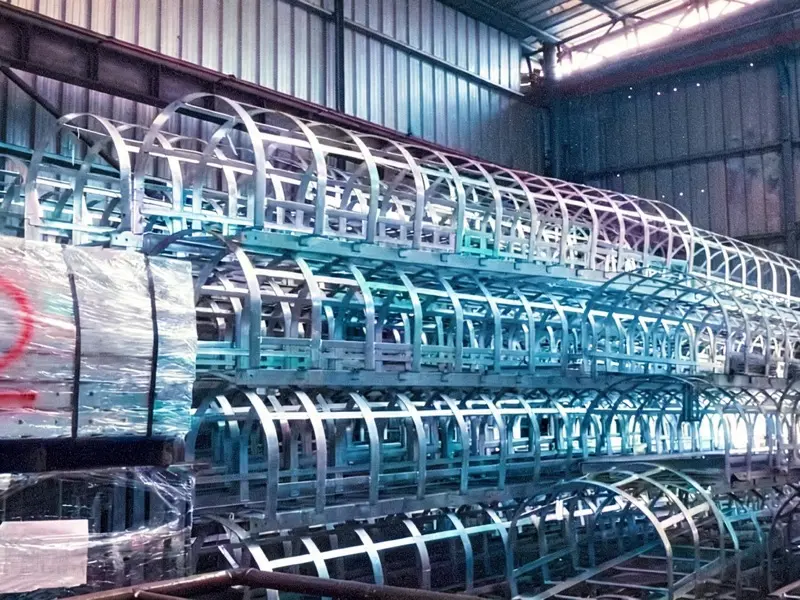
Australian Standard Cage Ladder Options
Australian Standard Cage Ladder
Full-height cages, material choice, and engineered parameters built to AS 1657.
Hot-Dip Galvanized
Q235B with HDG 85–100 μm per ISO 1461. Best all-round value for Australian outdoor and industrial use.
Stainless SS304
PMI-tested for chemical, coastal and food-grade environments. Acid-pickled and passivated.
Full-Height Cages
One-piece flights up to 14 m; bolted-splice single runs to 25 m; multi-run with rest platforms beyond. Widths and walk-throughs to your drawing.
| Specification | Value |
|---|---|
| Rung Diameter | Φ20 mm |
| Rung Spacing | 280 mm (≤300 mm) |
| Clear Width | 500 mm |
| Cage Diameter | Φ700 mm (hoops 40×5 @≤1500, straps 30×3) |
| Cage Start | 2.2 m above floor |
| Load Rating | 1.5 kN per rung |
| Entrance | Flared / flared splay entry |
| Galvanizing | HDG 85–100 μm (ISO 1461) |
| Standard | AS 1657:2018 |
Local Compliance Docs for AU Buyers
Local Compliance Docs for AU Buyers
Your site, your state, your WHS file — we prepare the documents your Australian project needs, ready for the handover folder.
- Project-specific DoC
Declaration of Conformity for your records
- AS 1657 conformity statement
Standard-by-standard compliance summary
- MTC 3.1 material certificates
EN 10204 3.1 for Q235B / HDG / SS304
DoC & AS 1657 Conformity Statement
DoC & AS 1657 Conformity Statement
Every Australian order ships with a written conformity statement that maps the build to AS 1657 section by section.
- DoC per project
Declaration of Conformity for your records
- AS 1657 conformity statement
Standard-by-standard compliance summary
- Volume pricing
Multi-ladder Australian sites quoted at volume
Australian Project Track Record
Caged ladders delivered to major Australian industrial operators (references on request).
See Our ProjectsWhat the State Regulator Tapes First
Inspector's Walkthrough — Australia Edition
A state WHS inspector does not quote AS 1657 at you — they measure the ladder and let the standard quote itself. Six numbers decide the visit: the climb against the 3.0 m trigger, the rung band, the hoop spacing, the back clearance, the platform intervals, and the thickness of your evidence file. Here is the walkthrough in the order it actually happens.
| Stop | Measured or Asked | What Passes |
|---|---|---|
| The climb against 3.0 m | tape from floor to top landing, plumb | above 3.0 m a cage or alternative exists — below it, geometry alone |
| Rung band | rung centre to rung centre at three heights | 225–300 mm throughout — ours reads 280 mm at every point |
| Hoop spacing | hoop to hoop vertically, and the strap count between | hoops at or under 1500 mm — ours are at 1500 with 30×3 straps |
| Back clearance | rung centreline to cage inside face | 650–800 mm — Φ700 geometry set at fabrication, not shimmed on site |
| Rest platforms | interval between platform landings on tall climbs | platforms at 6 m — multi-run layouts engineered at quote stage |
| The evidence file | what the PCBU can produce on the spot | DoC, AS 1657 conformity statement, MTC 3.1, calcs — in one folder, from day one |
The first five stops take fifteen minutes; the sixth takes ten seconds if the folder exists — and weeks if it does not.
Cage, System or Harness — the WHS Answer
Cage vs LSS vs PFAS Under the Australian Duty
WHS law asks for fall risks minimised so far as reasonably practicable — and AS 1657 accepts a cage or an alternative. Between those two sentences sits your decision. The table converts each site reality into the control that satisfies the duty and the hardware we ship for it.
| Site Reality | The Rule That Decides | Our Supply |
|---|---|---|
| Tank or silo climb over 3.0 m, normal access | the cage is the recognised default — cheapest control that satisfies the duty | full-height AS 1657 caged build, conformity statement included |
| Very tall climb, daily multi-user traffic | minimisation favours engineered systems over fatigue exposure | LSS-compatible ladder build with cage retained where layout allows |
| Confined or congested structure — cage will not fit | the alternative path exists precisely for this case | rail-compatible ladder for your fall-arrest integrator, geometry documented |
| Rare maintenance access, qualified climbers only | PFAS with certified anchorage can be the practicable answer | ladder with engineered anchor point in the same quote and DoC set |
| Existing sound ladder, cage missing | the duty exists today; retrofit closes it without replacement | cage modules to measured stringer geometry, hoops 40×5 at 1500 mm |
| Portfolio across states | same WHS model, state administration — one evidence standard everywhere | one compliance file format per ladder, whatever the state stamp says |
Describe the structure and the traffic — the control that satisfies the duty comes back in writing, with the clause, inside 24 hours.
Feature — Advantage — Your Outcome
Australian Orders — Features, Advantages, Outcomes
Five features on every Australian build, each answering a WHS or AS 1657 check.
| Feature | Advantage | Your Outcome |
|---|---|---|
| Cage from 2.2 m on every build | protection starts before the 3.0 m trigger | the trigger check passes on sight, with margin |
| Back clearance fixed at fabrication | 650–800 mm set by geometry, not by shims | clearance stop closes without adjustment work |
| AS 1657 conformity statement | clause-level recognition in writing | PCBU evidence produced in seconds, not weeks |
| 6 m platform layouts as standard | rest intervals designed into the GA drawing | tall climbs never argue about platform count |
| Volume tiers at 10 and 50-plus | site-wide programmes priced as programmes | rolling upgrades fit maintenance budgets |
Get an AS 1657 Quote
Get an AS 1657 Cage Ladder Quote
Tell us your state, height, material and quantity. An engineer replies within 24 hours with AS 1657 docs and an itemized quote.
- 24h AU quote with AS 1657 docs
- Volume pricing for multi-ladder sites
- DoC, conformity statement & MTC included
Deep Dive — The 3 m Rule and WHS Adoption
How AS 1657 and the WHS Laws Work Together Across Australia
Australian cage ladder compliance runs on two rails. The first rail is legal: the Work Health and Safety regulations in force in each state and territory place duties on persons conducting a business or undertaking — fall risks must be eliminated or minimised, and access plant must be maintained in safe condition. The second rail is technical: AS 1657:2018, the fixed platforms, walkways, stairways and ladders standard, which sets the geometry that satisfies those duties.
The number that surprises most overseas buyers is 3.0 m. Under AS 1657:2018, a fixed ladder climb above 3.0 m requires a cage or an alternative fall-protection measure — a stricter starting line than the OSHA 24 ft rule US teams are used to. That is why the Australian market leans toward full-height cages on short tank and silo ladders that would go uncaged in America, and why specifiers ask for the AS 1657 conformity statement by name.
The table below shows how the two rails connect, and what each contributes at procurement.
| Layer | What It Is | What It Decides for Your Ladder |
|---|---|---|
| WHS regulations — each state and territory | Legal duties on PCBUs for work at height | Whether fall protection is required and who is responsible for it |
| AS 1657:2018 — technical standard | Recognised compliance path under WHS | The geometry: 3.0 m cage trigger, ladder dimensions, hoop and platform rules |
| The 3.0 m rule | Cage or alternative fall protection above 3.0 m climb | Full-height cages become the default on short Australian ladders |
| Auditors and inspectors | State WHS regulators | Expect AS 1657 geometry when they walk the plant |
| Documentation | DoC, AS 1657 conformity statement, MTC 3.1 | The handover file we ship with every Australian order |
| Delivery program | Built to site dimensions | 15–25 working days production; 24 h quotes with volume pricing |
Practical takeaway for EPC and maintenance teams: do not translate a US ladder schedule straight into an Australian project. Audit the schedule against the 3.0 m trigger first, convert anything above it to a caged or LSS-equipped build, and request the AS 1657 conformity statement in the purchase order so the handover file is complete the day the container opens. Dengtai has fabricated caged ladders since 2004 and documents every Australian order to the standard your state regulator recognises.
Ladder Cage Requirements Australia FAQ
Related Pages
AS 1657 Cage Ladder Requirements
Section-by-section build standard
All Cage Ladders
Browse by type, material & application
Standards Hub
OSHA, EN ISO, BS, AS requirements
Ladder Cage Requirements
Height, hoop spacing & standards
Cage Ladder Australia
Australian supply & delivery
Get a Quote
24h itemized quote