 LadderCage
Fall Protection & Inspection Requirements
Cage Ladder Fall Protection Requirements
Cage ladder fall protection and inspection requirements — 24 ft rule, checklists, options. Free inspection checklist with every quote; OSHA 1910.28 & EN ISO 14122-4 compliant with test reports and DoC.
OSHA Threshold
EN ISO Threshold
Projects Delivered
Quote Response
Requirements Quick Reference
Cage Ladder Fall Protection Requirements
The rules in one table. If your fixed ladder crosses the 24 ft or 3 m threshold, fall protection is required — a cage, well, LSS or PFAS depending on the standard.
Get My Inspection Checklist| Requirement | Value |
|---|---|
| OSHA 1910.28 Threshold | 24 ft (7.3 m): LSS/PFAS required on ladders installed after Nov 19, 2018; cages grandfathered to Nov 18, 2036 |
| EN ISO 14122-4 Threshold | 3 m (9.8 ft) fall protection |
| Cage Start Height | 2.2 m above floor |
| Rung Spacing | 280 mm (≤300 mm) |
| Clear Width | 500 mm |
| Load Rating | 1.5 kN per rung |
| Inspection Records | QC records retained 10 years |
| Options | Cage · LSS · PFAS |
Inspection Requirements
Cage Ladder Inspection Requirements – Checklist
A compliant inspection covers every load-bearing and protective element. Our free checklist is built from the same five-stage QC we run in the factory.
- Rungs & Stiles
Bends, cracks, corrosion and secure fixings
- Cage Hoops & Straps
Spacing, continuity and welded connections
- Welds & Anchor Points
Crack-free welds, tight anchors, no missing bolts
- Clearances & Documentation
cage clearance 27–30 in maintained; records kept
Fall Protection Options
24 ft Rule & LSS/PFAS Options
Above the threshold you have choices. We supply caged ladders and can spec the alternative systems your project allows.
Safety Cage
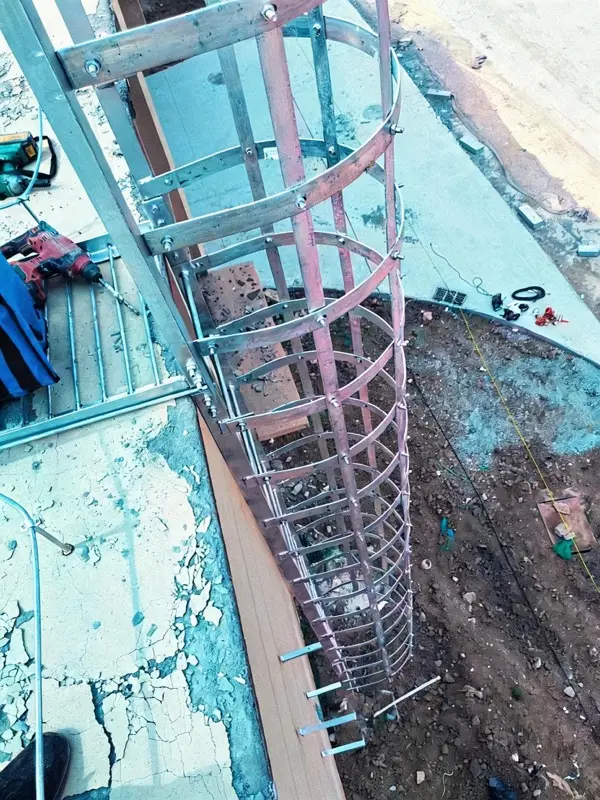
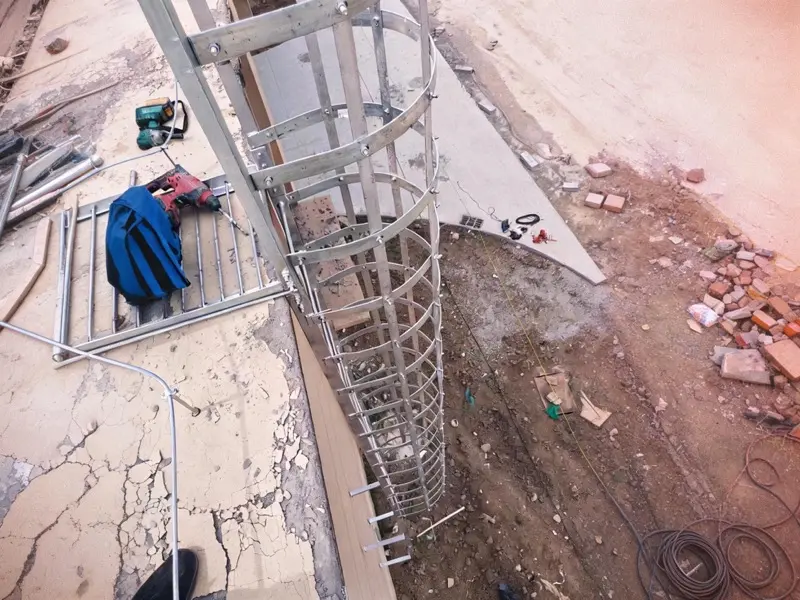
The classic OSHA/EN ISO solution — Φ700 mm hoops and straps from 2.2 m, fully compliant.
LSS — Ladder Safety System
Vertical rail and sliding sleeve system, an accepted alternative where standards permit.
PFAS — Personal Fall Arrest
Harness and anchor-based system, specified where a cage is impractical or prohibited.
Free Height & Inspection Checklist
Free Inspection Checklist
Request the free inspection checklist and a 24-hour quote. Use it to audit your existing cage ladders or spec a new compliant install.
Free Inspection Checklist
A practical, printable audit for rungs, cage, welds and clearances.
24-Hour Quote
Engineer replies within 24 hours with an itemized compliance quote.
Test Reports & DoC
Full compliance file supplied with any order — no chasing paperwork.
Compliance Documents
Compliance – Test Reports & DoC
Every cage ladder ships with the test reports and declarations your inspector expects — OSHA 1910.28 and EN ISO 14122-4, documented.
- Test Reports
Load and material test reports with each batch
- DoC Included
Declaration of Conformity to OSHA 1910.28 & EN ISO 14122-4
- QC Records 10 Years
Inspection records retained for traceability
What the Compliance Officer Actually Does
Inspector's Walkthrough — Fall Protection on Fixed Ladders
An OSHA compliance officer does not open with the cage — they open with a tape measure and the installation date. The dates decide which regime your ladder lives under: fixed ladders extending more than 24 ft above a lower level fall under 1910.28(b)(9), and since 19 November 2018 new ladders at that height require a ladder safety system or personal fall arrest system. Cages already in place were given until 18 November 2036. In September 2025 OSHA proposed removing the 2036 deadline; the rulemaking is not final, so plan to the current text.
| Walkthrough Stop | What Gets Measured or Asked | The Answer That Ends the Question |
|---|---|---|
| Stop 1 — the base | ladder height to the upper level; over 24 ft moves the ladder into 1910.28 territory | design height on the drawing plus installation date in the compliance file |
| Stop 2 — the cage | hoop spacing, cage width 27–30 in from centreline, flare at least 4 in at entry, cage top extending 42 in above the landing | fabrication drawing showing hoops at ≤1500 mm and Φ700 mm geometry |
| Stop 3 — the rungs | minimum 16 in clear width between stringers per 1910.23, uniform spacing, load capability | rung Φ20 mm at 280 mm on a 500 mm clear width — inside every limit |
| Stop 4 — the paperwork | who supplied it, to what standard, with what evidence — 1910.21 definitions frame the conversation | DoC, MTC 3.1 and structural calcs, delivered with the crate |
| Stop 5 — the dates | installed before or after 19 November 2018; grandfathered cage or LSS required | trial-assembly and dispatch photos date-stamped in the QC file we keep for 10 years |
Five stops, about fifteen minutes on your site — and every answer is a document you already hold if the ladder came from us.
Cage, LSS or PFAS — Pick by Situation
Fall Protection Path Selection Above 24 ft
The three systems are not interchangeable fashion — each one wins in a defined situation and loses outside it. Read the situation column honestly, then take the supply column to your RFQ.
| Situation | The Rule That Decides | Our Supply |
|---|---|---|
| 24 ft or less, any date | cage remains fully recognized fall protection below the threshold | caged ladder per 1910.23 geometry — cage from 2.2 m, Φ700 mm |
| Over 24 ft, ladder installed before 19 Nov 2018 | existing cage is grandfathered; removal deadline 18 Nov 2036, with the September 2025 proposal to strike it — pending, not final | keep the cage, document the install date; replacement cage modules if the original corrodes |
| Over 24 ft, new install after 19 Nov 2018 | ladder safety system or PFAS is required — a cage alone does not satisfy | ladder with rail-compatible stringer geometry, caged where the site also wants it below the threshold |
| Multi-user site, daily climbs, tools carried | LSS wins on speed — the sleeve travels with the climber, no tie-off choreography | vertical-ladder build with LSS-compatible centreline clear of rungs |
| Occasional maintenance access only | PFAS with a certified anchor is often the lightest compliant answer | ladder plus engineered anchor point, both in one quote and one DoC set |
| EN ISO or AS jurisdictions | different thresholds — cage above 3 m, system need above 10 m under EN ISO 14122-4 | build referenced to the standard your regulator enforces, named on the DoC |
State the climb height and install date — we return the correct path with the clause references inside 24 hours.
Feature — Advantage — Your Outcome
Fall Protection Features That Survive an Inspection
Each row pairs a build feature with the inspection outcome it produces.
| Feature | Advantage | Your Outcome |
|---|---|---|
| Cage geometry Φ700 mm, hoops at ≤1500 mm | inside the 27–30 in and 6 ft 6 in bands | tape-measure stop closes without a note |
| Date-stamped QC photo file | install-date evidence retained 10 years | grandfathering provable, not argued |
| DoC naming your governing clause set | 1910.23 or 1910.28 scope stated in writing | no ambiguity for the officer or your insurer |
| LSS-compatible stringer option | rail retrofit does not require ladder replacement | future-proofing at the price of a drawing line |
| Engineer-signed load calcs | 1.5 kN per rung demonstrated, not asserted | citation defence in one PDF |
Get an Inspection Requirements Quote
Get an Inspection Requirements Quote
Tell us your existing ladder type, height and inspection needs — you get a free inspection checklist and a 24-hour compliance quote.
- Free inspection checklist
- 24h compliance quote
- Test reports & DoC included
Deep Dive — Cage or Safety System
Cage, Ladder Safety System or Personal Fall Arrest — Choosing the Right Layer
Fall protection on a fixed ladder is not one decision but three: what the law permits, what the height triggers, and what your maintenance culture can actually sustain. A cage is passive — it protects every user with no training, harness or inspection regime beyond routine visual checks. A ladder safety system or personal fall arrest system is active — it arrests a fall, but it demands competent use, equipment checks and a rescue plan.
The regulatory triggers differ sharply by market. In the United States, OSHA 1910.28 requires fall protection above 24 ft: new ladders installed after the November 2018 cut-off must use a ladder safety system or PFAS, while existing caged ladders are grandfathered through November 18, 2036. In Europe, EN ISO 14122-4:2016 keeps the cage firmly in the design hierarchy from 3 m, adds rest platforms so no single climb exceeds 6 m, and requires a ladder safety system above 10 m. In Australia, AS 1657:2018 demands a cage or an alternative fall-protection measure above 3.0 m — closer to the European philosophy than the American one.
Use the selection table below to frame the decision before you specify.
| Decision Factor | Safety Cage | Ladder Safety System (LSS) | Personal Fall Arrest (PFAS) |
|---|---|---|---|
| How it protects | Passive enclosure — restricts the fall path | Continuous rail or cable with traveler device | Anchor, lanyard and full-body harness |
| US status (OSHA) | Existing pre-Nov 2018 ladders, grandfathered to Nov 18, 2036 | Required on new ladders above 24 ft after Nov 2018 | Accepted alternative to LSS above 24 ft |
| EN ISO status | Required from 3 m climb height | Required above 10 m, cage stays in place | Permitted where the risk assessment directs |
| User training burden | None beyond climbing rules | Device briefing for all climbers | Competent-person training plus rescue plan |
| Typical best fit | Tanks, silos, rooftops under 10 m; infrequent access | Tall towers, high-frequency access, US new builds | Mixed fleets already running a harness program |
| Our supply position | Factory-direct cages from USD 95 per meter HDG | Caged ladder built LSS-ready on request | Ladder engineered for anchor loads on request |
A practical pattern for global fleets: build the ladder and cage to EN ISO dimensions, keep climbs under 6 m with rest platforms, and add a ladder safety system wherever the 10 m threshold or a US new-install rule bites. One structure, layered protection, one compliance file — the DoC names the designated standard and the MTC 3.1 certificate proves the material behind it.