 LadderCage
Safe Entry, Engineered & Factory Direct
Confined Space Cage Ladder
Confined space cage ladders for safe entry and exit – welded steel, OSHA-ready, WSH & EN 14122-4 docs included. Quote in 24 hours.
Projects Delivered
Countries Exported
Quote Response
Standards Covered
Complete Entry Solution
Confined Space Entry Ladder – Safe Access Solutions
A confined space entry route is more than a ladder. We deliver the vertical ladder, safety cage and entry hardware as one engineered package, so one supplier covers the whole route.
- Safe Entry & Exit
Vertical access with cage from 2.2 m and flared splay entry
- Complete Entry Solution
Ladder + safety cage + access engineered as one package
- OSHA-Ready Build
Welded steel construction to OSHA 1910.146 and WSH rules
Three-Standard Compliance
OSHA 1910.146, WSH & EN ISO 14122-4 Compliance
Confined space entry is governed by multiple standards. We engineer one ladder that satisfies OSHA 1910.146, WSH Work at Heights and EN ISO 14122-4, and ship the compliance file with every order.
- DoC – OSHA 1910.146 / WSH / EN ISO 14122-4
Declaration of Conformity to the standard that applies to your site
- MTC 3.1 Material Certificate
EN 10204 3.1 for Q235B / HDG / SS304
- Structural Calculation Sheet
Engineer-signed for project loads
| Standard | Scope |
|---|---|
| OSHA 1910.146 | Permit-required confined space entry |
| WSH (Work at Heights) | Fall protection on tall access ladders |
| EN ISO 14122-4 | Fixed ladder geometry, rungs and caging |
Specifications
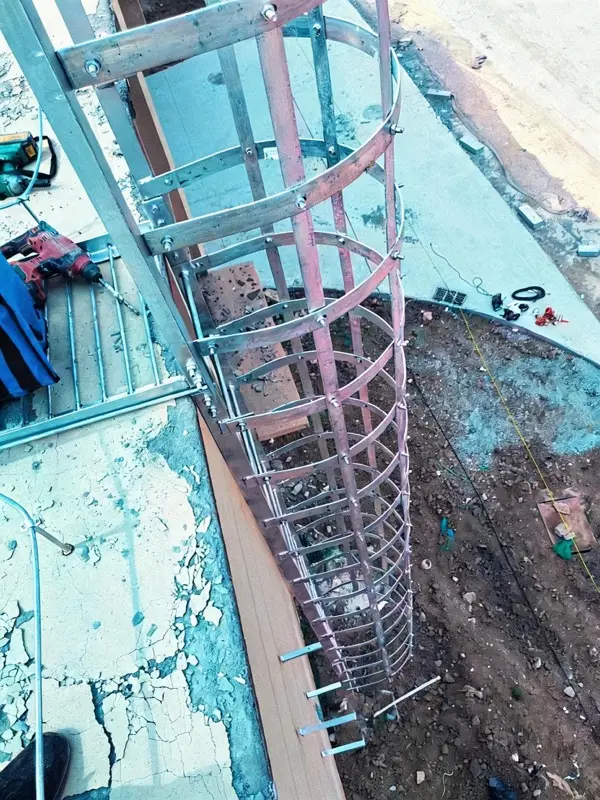
Confined Space Ladder Specifications
Engineered parameters for every confined space entry ladder, made-to-order to your entry depth and material.
| Specification | Value |
|---|---|
| Rung Diameter | Φ20 mm |
| Rung Spacing | 280 mm (≤300 mm) |
| Clear Width | 500 mm |
| Cage Diameter | Φ700 mm (hoops 40×5 @≤1500, straps 30×3) |
| Cage Start | 2.2 m above floor |
| Load Rating | 1.5 kN per rung |
| Entrance | Flared / flared splay entry |
| Standards | OSHA 1910.146 · WSH · EN ISO 14122-4 |
Factory-Direct & Proven
Factory-Direct Pricing & 24h Quote
Buy direct from the production floor, quote in 24 hours, with a free entry-solution review. Trusted for sewage and industrial projects across 500+ deliveries in 50+ countries.
Factory-Direct
No distributor markup. Quote straight from the Dengtai production line.
24h Quote & Entry Review
Itemized quote plus a free confined space entry solution review.
Sewage & Industrial Track Record
Proven on wastewater, tank and duct entry projects worldwide.
Get a Confined Space Ladder Quote
Get a Confined Space Ladder Quote
Tell us the entry type and depth – our engineers reply within 24 hours with an entry solution review, compliance notes and a quote.
- 24h itemized quote
- Free entry solution review
- DoC, MTC & structural calcs included
Getting In, Getting Out, Getting Help
Confined Space Entry & Rescue Configurations
The entry pattern decides how an entrant escapes and how a rescuer reaches them. These are the four layouts we engineer for permit spaces — each pairs an access route with the rescue behavior your safety plan needs to assume.
| Entry Pattern | Best For | Rescue Consideration |
|---|---|---|
| Straight caged vertical | Shallow pits and sumps with short climbs | Retrieval line from the top anchor; cage funnels a slip back to the rungs |
| Side-exit platform | Deep shafts where entrants need a resting way out | Rescuers stage at the platform instead of a full descent |
| Fold-back switchback | Tall vessels with limited plan area | Shorter falls per leg; entrant exits at each reversal |
| Through-hatch entry | Tanks and towers entered from the roof | Hatch stays open during occupancy; anchor ring carries the climb loads |
Site Walkthrough
A Digestor Shaft Entry, Drilled With the Rescue Team Present
Elena is plant manager at a municipal wastewater works. The 7 m digestor shaft gets four permit entries a year, the internal ladder corroded past safe use in 2024, and the rescue team has views about how an incapacitated entrant comes out. Here is the project with the rescue plan in the room from day one.
Elena walks the shaft with the entry supervisor and a rescue-team lead: shaft depth and diameter, atmosphere class, the gas-monitor and tripod anchor points at the top, and the corroded rail itself. The rescue lead states his requirement — an entrant must be bringable out sideways, not hauled 7 m vertically.
Our engineers return the design: caged run at 500 mm width for an entrant with a harness and airline, a side-exit platform at mid-depth so the rescue drill stages a horizontal retrieval, rungs Φ20 at 280 mm rated 1.5 kN, SS316 for the sulfide atmosphere — 2.5x the HDG price and worth every cent of it here.
The shaft is treated as a permit space for the last time before handover: ventilated, monitored, attended. The trial-fitted SS316 run lowers in one piece and bolts to cast-in anchors — four hours of permit work instead of three days of site welding, then the atmosphere test runs clear behind the crew.
Acceptance is a live exercise: a weighted dummy down the shaft, retrieval through the side exit in under the plan time, every rung and cage hoop inspected from inside. The MTC 3.1, DoC and QC photos join the permit file — and the next four entries a year run on the new climb.
| Survey Checklist (you bring) | Acceptance Checklist (you verify) |
|---|---|
| Shaft depth, diameter and atmosphere class | SS316 verified on the MTC |
| Rescue team's retrieval method — side or vertical | Side-exit platform staged and drill-tested |
| Existing anchor points for tripod and lines | Cage Φ700, hoops 40×5 @≤1500 in place |
| Condition of the ladder being replaced | Rungs Φ20 @280 mm, 1.5 kN rated |
| Entry frequency the new climb must serve | DoC, MTC 3.1, drill record in permit file |
Decision Guide
Confined Space Decisions: Choose This When…
In a permit space, the rescue plan is a design input. Four forks settle the entry build.
| Decision | Choose X when… | Choose Y when… |
|---|---|---|
| Exit pattern | Side-exit platform at depth — rescue plans that retrieve horizontally, entrants wearing airlines who need a resting way out | Straight caged vertical with top retrieval — shallow sumps where a tripod and winch reach the bottom in seconds |
| Material | SS316 (2.5x) — sulfide and biogas atmospheres, wastewater and chemical spaces where pitting is a permit-stop | HDG Q235B from $95/m — dry shafts and vaults with clean air and infrequent entries |
| Entry geometry | Through-hatch from the roof — tanks and towers where the roof is the only opening and the hatch carries the climb | Straight-in from grade — pits and sumps with a plan-level opening beside the shaft |
| Install method | Trial-fitted one-piece bolt-up — one permit entry of four hours, atmosphere cleared behind the crew | Site-welded assembly — spaces too large for one piece, scheduled under an extended permit with ventilation running |
The mistake of pricing the ladder without the rescue plan
- The mistake: ordering the cheapest straight vertical to replace the corroded rail, and only then asking the rescue team how they would get an unconscious entrant out of a 7 m shaft.
- The consequence: vertical retrieval of a dead weight through a Φ700 cage defeats the drill every time it is practiced — the entry permit gets refused, and the ladder you paid for becomes steel the rescue plan will not accept.
- The correct move: put the rescue method in the RFQ before anything else — we engineer the side exit or the retrieval geometry around it, and the free drawing review shows the drill on paper before you commit.
Feature · Advantage · Outcome
What the Confined Space Build Buys You
| Feature | Advantage | Your Outcome |
|---|---|---|
| Rescue-led exit design | side exit or retrieval built into the drawing | the permit gets signed, every entry |
| SS316 for sour atmospheres | pitting resistance where HDG surrender | no corrosion-based permit stops for decades |
| One-piece trial-fitted install | a single four-hour permit entry | the shaft spends less time open, not more |
| 500 mm width, 1.5 kN rungs | entrant climbs with harness and airline | kit on, forward-facing, both hands on rungs |
| Drill-tested acceptance | handover runs the actual rescue plan | you know it works before you need it to |