 LadderCage
Factory-Direct Sewage Pump Station Cage Ladder
Sewage Pump Station Cage Ladder
Pump station & sewer cage ladders — hot-dip galvanized, corrosion resistant. OSHA 1910.28 & EN ISO 14122-4 compliant.
Years Manufacturing
Export Countries
Projects Delivered
Quote Response
Sewage Pump Station Cage Ladder Applications
Sewage Pump Station Cage Ladder
Built for pump stations, sewage plants and sewer access — corrosion resistant by default. Rated 1.5 kN per rung and compliant out of the box.
Pump Stations
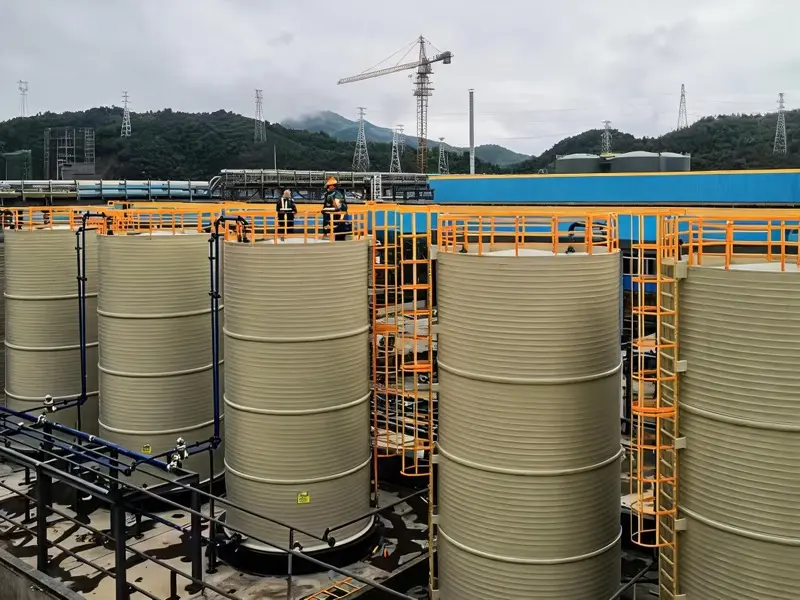
Wet well and pump house access in humid, corrosive atmospheres — HDG 85–100 μm as standard, SS304 where chemical dosing is used.
Sewage Plants
Treatment tank and platform access across the plant, engineered to OSHA 1910.28 with test reports included.
Sewer & Utility Access
Manhole and utility access routes in aggressive environments — SS316 available for saltwater or chemical contact.
Pump Station Cage Ladder Materials
Pump Station Cage Ladder Options
Corrosion-resistant by default — pick your grade and every option ships with DoC, MTC and test reports.
Hot-Dip Galvanized
Q235B with HDG 85–100 μm per ISO 1461. C4–C5 marine grade available for coastal pump stations.
Stainless SS304
PMI-tested for chemical dosing areas and washdown environments. Acid-pickled and passivated.
Stainless SS316
Molybdenum-grade for saltwater, chloride and aggressive sewer gas environments.
Corrosion-Resistant Specifications
Sewer Cage Ladder - Corrosion-Resistant Specs
Every pump station cage ladder is made-to-order with the engineered parameters below, ready for your site review.
Get My Pump Station Quote| Specification | Value |
|---|---|
| Rung Diameter | Φ20 mm |
| Rung Spacing | 280 mm (≤300 mm) |
| Clear Width | 500 mm |
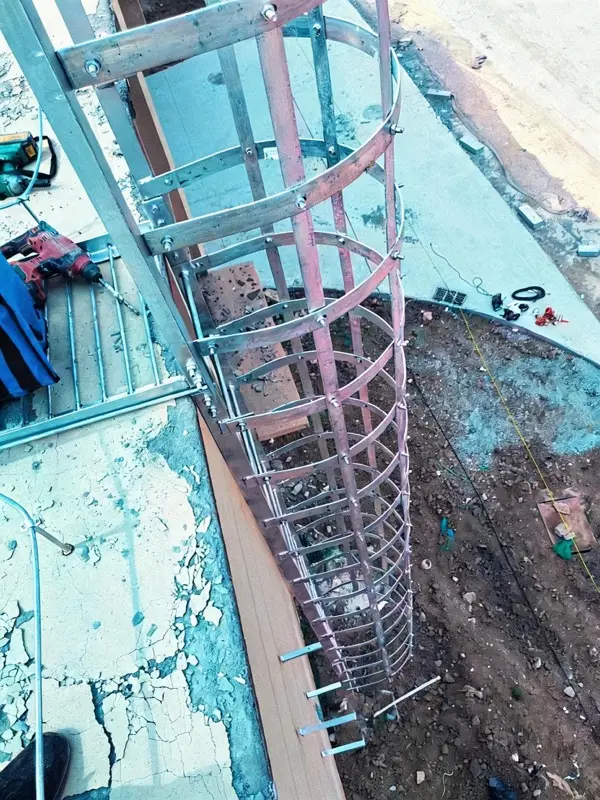
| Cage Diameter | Φ700 mm (hoops 40×5 @≤1500, straps 30×3) |
| Cage Start | 2.2 m above floor |
| Load Rating | 1.5 kN per rung |
| Galvanizing | HDG 85–100 μm (ISO 1461), C4–C5 marine optional |
| Stainless | SS304 / SS316 optional |
| Standards | OSHA 1910.28 · EN ISO 14122-4 |
Compliance Docs: DoC, MTC & Test Reports
Compliance & Documentation (OSHA / EN ISO 14122-4)
Water and wastewater projects need paperwork they can hand to an inspector — every cage ladder ships with its full compliance file.
- DoC — OSHA 1910.28 & EN ISO 14122-4
Declaration of Conformity to the relevant standard
- MTC 3.1 Material Certificate
EN 10204 3.1 for Q235B / SS304 / SS316
- Test Reports Included
Galvanizing thickness and material verification reports
Volume Pricing
Volume Pricing & Fast Delivery
Volume pricing for sewage pump station projects. Ships in 15–25 days; quote in 24 hours.
Volume Pricing
Pump station projects often need many ladders — multi-unit and site-wide orders priced at volume.
24h Quote
Engineer replies within 24 hours with an itemized, no-hidden-fees breakdown.
Ships in 15–25 Days
Exact dispatch date confirmed in your quote — no surprise delays on site.
Water & Wastewater Projects
Sewage plants, pump stations and water recovery facilities across 50+ countries. References are anonymized; ask for sector-relevant case details on request.
Get a Pump Station Cage Ladder Quote
Get a Sewage Pump Station Cage Ladder Quote
Tell us your scenario, height, material and quantity. An engineer replies within 24 hours with an itemized quote and test reports.
- 24h itemized quote
- Volume pricing on multi-ladder projects
- DoC, MTC & test reports included
Getting Out of a Confined Chamber: Four Exit Strategies
A pump station wet well is the tightest climbing environment most utilities own. The shaft diameter was set by the pump package, not by ladder comfort, and the slab opening rarely sits where the drawings promised. The exit strategy — how a climber leaves the ladder and ends up standing safely at grade — has to be chosen deliberately, because retrofitting the wrong one inside a confined space is the most expensive kind of correction.
These are the four arrangements we configure for station work, with the footprint behavior each one trades away.
| Exit Strategy | Best For | Footprint in the Well | Price Guide |
|---|---|---|---|
| Side step-through exit | Openings offset from the shaft wall | Keeps the vertical run tight to one side | $90–250 per exit group |
| Walk-through at slab level | Operator steps through the guardrail | Needs headroom at the top rung | $90–250 with gate at $60–180 |
| Fold-back return run | Very deep wells with tight diameter | Halves the single-run exposure | Quoted per geometry |
| Rest platform mid-run | Climbs following the 6 m platform rule | Adds a landing inside the shaft | $150–400 each |
Site Walkthrough
A Wet Well Ladder Project With the Rescue Plan Built In
Ken supervises twelve sewage lift stations for a municipal utility. Every wet well descent is a confined space entry, and the H2S eats cheap steel in under five years. Here is how the Station 5 ladder replacement ran, rescue considerations first.
Ken's crew, under a confined space permit, measures deck-to-wet-well depth, the shaft footprint, hatch opening size, and where the guide rails and discharge header run. Gas history and wash-down practice decide the material — sewage vapor zones point straight to SS304 or SS316.
Our engineers draw the exit as a side-step landing or fold-back top, because a rescuer hauling a colleague must never fight a cage ring at the lip. Sections are sized to pass through the existing hatch — the deck never gets cut.
The trial-fitted sections drop through the hatch and bolt to the shaft wall under the same entry permit — no welding in a gas-bearing shaft. The crew is out of the well before the ventilation run finishes, and the station never lost a pumping hour.
Acceptance ends with a retrieval drill, not a tape measure: attendant at the top, dummy haul through the side exit, rung and cage geometry verified (280 mm, Φ700 from 2.2 m), MTC 3.1 and DoC filed with the utility's confined space program.
| Survey Checklist (you bring) | Acceptance Checklist (you verify) |
|---|---|
| Deck-to-wet-well depth and shaft footprint | Side or fold-back exit clears the cage for rescue |
| Hatch opening size for section entry | Sections passed through without deck cutting |
| Guide rail and discharge header positions | No interference with pump retrieval paths |
| Gas history and wash-down practice | SS304 or SS316 in the vapor zone as specified |
| Confined space program requirements | Retrieval drill passed; MTC 3.1 and DoC filed |
Decision Guide
Pump Station Ladder Decisions: Choose This When…
A wet well ladder is confined space equipment. These four forks decide whether it protects the entrant or becomes the hazard.
| Decision | Choose X when… | Choose Y when… |
|---|---|---|
| Material | SS304 (1.8x) — typical sewage vapor zones where the utility wants a set-and-forget climb | SS316 (2.5x) — high-sulfide wells and industrial discharge; HDG only for dry well and outdoor runs out of the vapor |
| Exit geometry | Side-step exit at the landing — rescuers clear the cage ring with a loaded haul | Fold-back top rungs — narrow shafts where the hatch lip and guide rails leave no side room |
| Sectioning | Hatch-sized bolted modules — sections pass through the existing deck opening | Full-length piece to 14 m — open stations and new builds with crane access from the start |
| Top security | Lockable self-closing gate ($60–180) — stations in public reach need entry control | Open guardrail exit — fenced utility sites with controlled key access |
The mistake that turns a ladder into an obstacle
- The mistake: installing a straight caged run that tops out through a narrow hatch ring, copied from a warehouse wall ladder drawing.
- The consequence: a rescuer hauling an unconscious entrant cannot clear the cage and hatch together, the rescue window closes, and the utility inherits the finding at the next program audit.
- The correct move: put the confined space program on the RFQ — we draw side-step or fold-back exits sized for a loaded retrieval and verify section sizes against your hatch before you commit.
What You Get
Pump Station Features, Translated to Confined Space Outcomes
What each design line means the day the alarm sounds.
| Feature | Advantage | Your Outcome |
|---|---|---|
| Rescue-oriented exit geometry | side-step or fold-back clear of the cage | retrieval drills pass, entrants protected |
| Hatch-sized bolted modules | sections enter through existing deck | no cutting, one entry permit, hours saved |
| Vapor-zone stainless options | SS304 or SS316 where H2S rules | no five-year rust-out in the well |
| No-weld shaft installation | bolting only inside the shaft | zero ignition and gas risks during install |
| Utility audit documentation | MTC 3.1, DoC, galvanizing certificates | program audits close with one file |