 LadderCage
Tall-Structure Access, Factory Direct
Water Tower Cage Ladder
Water tank and tower cage ladders – galvanized steel, custom heights for tall tanks. EN ISO 14122-4 & OSHA compliant, DoC with every order, and free drawing review.
Projects Delivered
Countries Exported
Quote Response
Max Single Run
Height Capability
Water Tank Cage Ladder – Custom Heights
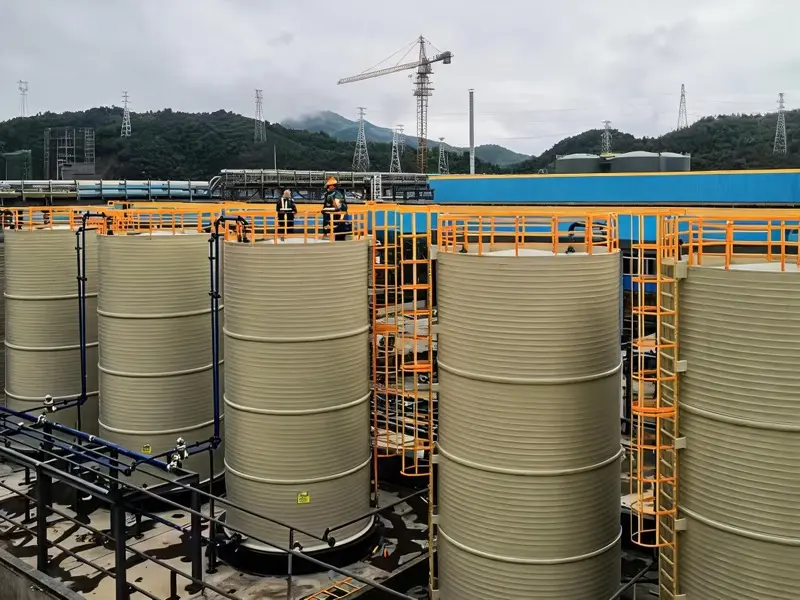
Water towers are tall by design. We engineer cage ladders for the full height of your tank or tower — long single runs, section joints for transit, and rest platforms where the height demands it.
- Custom Heights for Tall Tanks
Single runs to 25 m; multi-run systems with rest platforms beyond
- Sectional for Transit
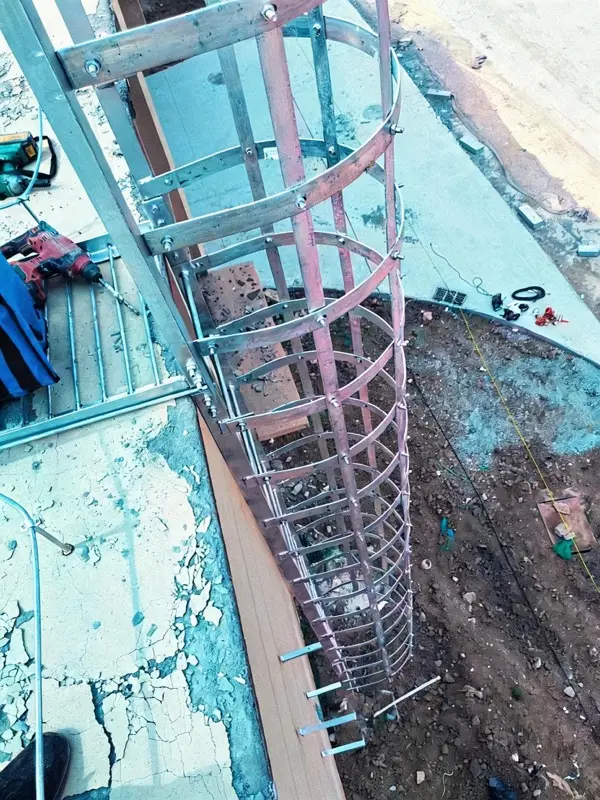
Flanged sections that bolt together on site for tall towers
- Free Drawing Review
Engineer check of your tower height and tank type before production
Material Selection
Galvanized & SS304 Options
Pick the corrosion profile that matches your site. Both options are engineered to the same EN ISO 14122-4 & OSHA geometry.
Hot-Dip Galvanized (HDG)
Q235B with HDG 85–100 μm per ISO 1461. The default for outdoor water towers — cost-effective and proven in wet climates.
Stainless SS304/SS316
PMI-tested for coastal sites, water treatment and potable-water facilities where corrosion resistance or hygiene matters most.
Specifications
Tall Tower Access Engineered
Every water tower cage ladder is made-to-order with the engineered parameters below, sized for your tank height and diameter.
Get My Water Tower Quote| Specification | Value |
|---|---|
| Rung Diameter | Φ20 mm |
| Rung Spacing | 280 mm (≤300 mm) |
| Clear Width | 500 mm |
| Cage Diameter | Φ700 mm (hoops 40×5 @≤1500, straps 30×3) |
| Cage Start | 2.2 m above floor |
| Load Rating | 1.5 kN per rung |
| Material | Q235B HDG (ISO 1461) / SS304 |
| Standards | EN ISO 14122-4 · OSHA 1910.28 |
Compliance & Track Record
Compliance – DoC with Every Order
Water and utility projects are audited. Every water tower cage ladder ships with its full compliance file, backed by a delivered track record across utilities and EPC projects.
- DoC — EN ISO 14122-4 & OSHA
Declaration of Conformity to the relevant standard
- MTC 3.1 Material Certificate
EN 10204 3.1 for Q235B HDG / SS304
- Utility & EPC Track Record
Delivered across 500+ projects in 50+ countries
- Factory-Direct Value
Compare against imported tower access systems at 2–3× the price
Get a Water Tower Cage Ladder Quote
Get a Water Tower Cage Ladder Quote
Tell us your tower height, tank type and material preference — our engineers reply within 24 hours with a free drawing review, DoC notes and an itemized quote.
- 24h itemized quote
- Free drawing review
- DoC & MTC included with every order
Match the Steel to the Water Service
Water infrastructure is rarely one environment. A potable tank exterior in a dry inland county, a sewage contact zone at a lift station, and a wash-down chamber at a treatment plant attack steel at completely different rates. Specifying one material across a whole utility either wastes budget or shortens service life.
Use this selector before requesting quotes — the price column shows the honest cost step between finishes, starting from $95 per meter in galvanized Q235B.
| Water Service | Recommended Material | Price Guide | Why It Holds Up |
|---|---|---|---|
| Potable tank exterior, inland | HDG Q235B per ISO 1461, 85–100 μm | From $95/m | Zinc coating shrugs off rain and humidity for decades of municipal duty |
| Wash-down and treatment plant zones | SS304 | About 1.8x HDG | Survives constant moisture and cleaning chemicals without coating damage |
| Sewage and biogas contact | SS304 with sealed welds | About 1.8x HDG | ISO 5817 Level C weld inspection leaves no crevices for aggressive gases |
| Coastal or high-chloride water | SS316 | About 2.5x HDG | Molybdenum-bearing grade resists chloride attack near the sea |
Site Walkthrough
A Water Tower Ladder Project, Start to Finish
Meet Daniel, operations supervisor for a district water utility. Tower TW-07 needs its rusted ladder replaced before the state sanitary survey, and the tank cannot come out of service in summer demand. Here is how the project actually runs.
Daniel measures the shell height to the roof manway, the tank diameter at the climb line, and photographs the coating condition, the existing roof handrail, and the overflow pipe location. We check chlorine and chloramine levels in his system report — that single number decides HDG versus SS304.
Our engineers lay the climb on the shell away from the overflow and the sampling tap, clamped on saddles that never penetrate the potable coating. Daniel receives the GA drawing, bracket plan and calculation sheet within days, reviews them with his inspector, and signs one revision.
No drain-down, no entry permit. A two-person crew and a crane set the trial-fitted run in single pieces, bolts the cage hoops, and fits the self-closing gate at the roof rail. Because every bolt hole aligned at the factory, the crew is off the rope access schedule by afternoon.
Daniel walks the state inspector up the new ladder with the file in hand: MTC 3.1, DoC to EN ISO 14122-4, HDG thickness readings of 85–100 μm, and the factory photographs archived for ten years. The ladder passes; the water system never stopped flowing.
| Survey Checklist (you bring) | Acceptance Checklist (you verify) |
|---|---|
| Shell height to roof manway and tank diameter | Rungs Φ20 at 280 mm, 500 mm clear width |
| Disinfectant type and dose (chlorine / chloramine) | Cage Φ700 from 2.2 m, hoops 40×5 at 1500 mm |
| Roof handrail and overflow pipe positions | Self-closing gate closes under its own weight |
| Coating type and condition photos | No penetration through the potable coating |
| Sanitary survey date | MTC 3.1, DoC and QC photo file on record |
Decision Guide
Water Tank Ladder Decisions: Choose This When…
Water utility ladders live or die on three choices — the material against your disinfectant, the climb route on the structure, and how the run breaks on tall towers. The table below mirrors the questions our engineers ask on the first call.
| Decision | Choose X when… | Choose Y when… |
|---|---|---|
| Material | HDG Q235B at $95/m — inland potable tanks where the disinfectant is plain chlorine and the budget is public money | SS304 at 1.8x — coastal sites, chloramine systems, or wash-down zones where the coating would age twice as fast |
| Climb route | Shell-mounted saddle brackets on a ground storage tank — shortest climb, straight to the roof manway | Leg-mounted standoff frame on an elevated tower — the climb rides the leg with the shell kept clear of fixings |
| Rung breaks | Single run up to 14 m — one fabricated piece, one crane lift, one inspection joint count | Rest platform ($150–400) near every 6 m — towers above the EN ISO 14122-4 single-climb comfort and your insurer's rules |
| Roof exit | Walk-through exit into the roof handrail — operators top out holding rail, not air | Side-step exit with a $60–180 self-closing gate — when the manway or vent crowd blocks the direct route |
The mistake that shortens water ladder life
- The mistake: specifying hot-dip galvanized steel downwind of a chloramine dosing room because it saved budget on the last project.
- The consequence: the vapor plume strips the zinc in a few years, the cage hoops thin first, and the utility pays for a second ladder plus an emergency contract.
- The correct move: send us the disinfectant type and dosing with your RFQ — we recommend HDG or SS304 per exposure zone in writing, free, before you commit to either.
What You Get
Water Tower Ladder Features, Translated to Utility Outcomes
What each specification earns you when the sanitary survey team arrives.
| Feature | Advantage | Your Outcome |
|---|---|---|
| No-penetration saddle mounting | potable coating stays intact | zero contamination risk, tank warranty preserved |
| Disinfectant-matched material call | HDG or SS304 selected per exposure zone | one ladder for the design life, not a re-buy |
| In-service installation design | no drain-down, no confined entry | the district keeps full storage through the swap |
| Self-closing roof gate ($60–180) | guardrail closes behind every climb | roof-edge compliance without policing behavior |
| Survey-ready document file | MTC 3.1, DoC, HDG readings, 10-year photo archive | state inspection passes on paperwork, not promises |