 LadderCage
Tall-Structure Access, Factory Direct
Chimney & Cooling Tower Cage Ladder
Chimney & cooling tower cage ladders – Q345B steel, custom tall heights, structural calcs with every order. EN ISO 14122-4 & OSHA compliant.
Projects Delivered
Countries Exported
Quote Response
Max Single-Run
Tall-Structure Applications
Chimney Cage Ladder – Tall Structure Access
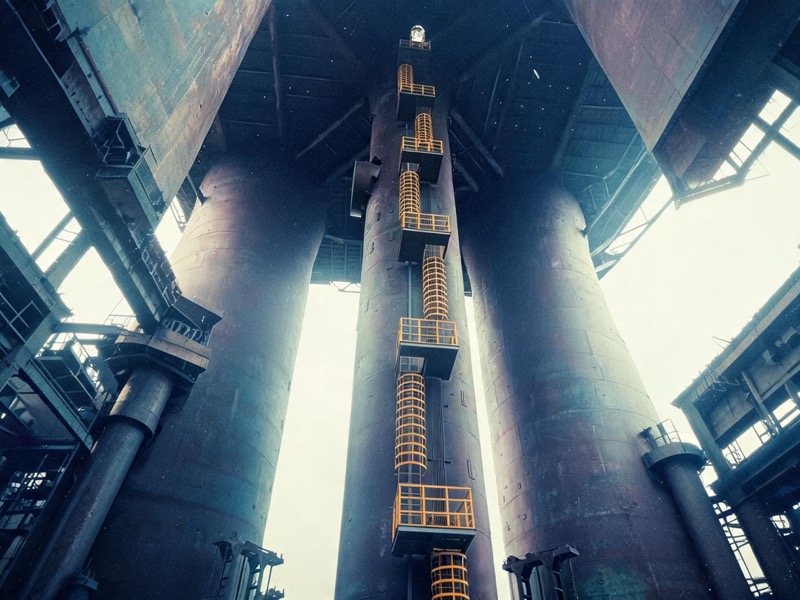
Chimneys and cooling towers need maintenance access at height. We engineer cage ladders for the full structure, from base to top.
Chimney Access
Heavy-duty cage ladders to chimney stacks, with structural calcs for wind load and stack height.
Cooling Tower Access
Reliable access routes up cooling towers for inspection and maintenance of fans and fill.
Height & Strength Capability
Q345B Heavy-Duty Steel for High Structures
Tall structures demand more than standard sections. We use Q345B higher-strength steel for heavy-duty chimney and cooling tower ladders, and build single runs to 25 m, with multi-run systems and rest platforms beyond that.
- Custom Tall Heights (25 m+)
Single runs to 25 m; multi-run systems with rest platforms beyond
- Q345B Heavy-Duty Sections
Higher-strength steel for tall structures and high wind loads
- Engineer-Verified Design
Structural calcs included with every order
Specifications
Chimney & Tower Ladder Specifications
Engineered parameters for every chimney and cooling tower cage ladder, in Q345B heavy-duty where your structure needs it.
| Specification | Value |
|---|---|
| Rung Diameter | Φ20 mm |
| Rung Spacing | 280 mm (≤300 mm) |
| Clear Width | 500 mm |
| Cage Diameter | Φ700 mm (hoops 40×5 @≤1500, straps 30×3) |
| Cage Start | 2.2 m above floor |
| Load Rating | 1.5 kN per rung (Q345B heavy-duty available) |
| Entrance | Flared / flared splay entry |
| Standards | EN ISO 14122-4 · OSHA 1910.28 |
Structural Calcs & Compliance Documents
Structural Calcs & Compliance Documents
High structures need verified engineering. Every order ships with structural calculations and its full compliance file.
- Structural Calculation Sheet
Engineer-signed for your structure height and load
- DoC – EN ISO 14122-4 & OSHA
Declaration of Conformity to the relevant standard
- MTC 3.1 Material Certificate
EN 10204 3.1 for Q235B / Q345B / HDG
- Power & Industrial Track Record
Delivered across 500+ projects in 50+ countries
Get a Tower Ladder Quote
Get a Tower Ladder Quote
Tell us the structure type, height and whether you need Q345B heavy-duty – our engineers reply within 24 hours with a drawing review, structural calc notes and a quote.
- 24h itemized quote
- Free structural calculation
- DoC & MTC included
Specifying the Climb by Height Zone, Not as One Ladder
A stack is three different environments stacked on top of each other. The base sits in ambient air and yard traffic, the band around the flue breach carries heat that moves the shell every time the plant loads up, and the exposed upper third takes the full weather load with nothing to break the wind. A ladder built to one spec for all three zones either fails at the breach or wastes steel at the base.
This is how a tall stack run is divided before the first section is cut.
| Stack Zone | Conditions | Ladder Provision | Typical Add-On |
|---|---|---|---|
| Base zone | Ambient air, vehicle wash and yard dust | Standard caged run, HDG Q235B or Q345B | Anti-climb considerations at grade |
| Flue breach band | Shell heats and moves with load cycles | Slotted connections and expansion gaps in the run | Breach platform at $150–400 |
| Upper third | Full wind and weather exposure | Continuous cage — 700 mm rings, hoops 40 x 5 at 1500 mm | Rest platforms at 6 m intervals |
| Stack top | Worst weather, aviation environment | Heavy-duty hoops with top landing and gate | Self-closing gate at $60–180 |
Site Walkthrough
A typical 40 m stack project Where Heat Writes the Rules
Dmitri is the plant engineer for a refinery process heater stack. The old ladder fights the stack every time it heats — rigid brackets, torn welds, an inspection climb nobody wants. Here is the replacement project, expansion gap first.
Dmitri pulls the stack data sheet: shell height and diameter taper, operating and startup metal temperatures, wind region, and the aviation obstruction marking line. The survey crew photographs anchor zones at each platform level and confirms where the flue ducts crowd the climb.
Our engineers compute the axial growth between ambient and operating temperature and place a sliding expansion joint in the ladder at the calculated level — the stack stretches on startup, the ladder does not fight it. Standoff brackets keep the cage off the hot shell face.
The 40 m run ships in flanged, trial-fitted sections and goes up during the heater outage with the stack cold. Crews bolt sections in sequence, set the expansion joint at its cold setting, and torque the standoff brackets to the calculation sheet.
The first full-fire startup is the real acceptance: the stack grows, the joint slides, nothing tears. Dmitri files rung and cage checks, MTC 3.1, DoC and the QC photo file — an inspection record that survives the next shutdown cycle intact.
| Survey Checklist (you bring) | Acceptance Checklist (you verify) |
|---|---|
| Stack height, diameter and taper drawing | Expansion joint set to cold position |
| Operating and startup metal temperatures | Cage standoffs clear of hot shell face |
| Wind region and aviation marking line | Rungs 280 mm, cage Φ700 from 2.2 m |
| Platform levels and anchor zones | Flange bolts torqued to calculation sheet |
| Outage window for cold-stack install | Post-startup walk confirms joint travel |
Decision Guide
Chimney Ladder Decisions: Choose This When…
Stacks move, glow and catch wind. Four forks decide whether the ladder lives with the stack or against it.
| Decision | Choose X when… | Choose Y when… |
|---|---|---|
| Expansion handling | Sliding expansion joint in the ladder run — hot stacks above roughly 150 °C where axial growth is measured, not guessed | Rigid anchored run — cold stacks, cooling towers and vent stacks operating near ambient |
| Standoff | Deep standoff brackets — stacks with insulation or hot shell faces radiating at the climb line | Close saddle brackets — ambient stacks and cooling tower shells where the surface never moves in temperature |
| Material | HDG Q235B — refinery and boiler stacks inland, where zinc handles the weather side | SS316 (2.5x) — coastal stacks and flue gas condensate carrying chlorides at the top third of the climb |
| Run architecture | Flanged multi-section run with rest platforms ($150–400) — 40 m stacks capped by EN ISO 14122-4 climb rules | Single pieces to 14 m — short vent stacks and cooling tower climbs with one crane day |
The mistake that tears a ladder off a stack
- The mistake: anchoring a rigid ladder the full height of a hot stack with no expansion provision, because "the old one never had a joint either".
- The consequence: every heat cycle loads the brackets until welds tear and anchors walk — the inspection that flags it also closes the stack until repairs, exactly what the old ladder already proved.
- The correct move: send the operating temperatures with the RFQ — we compute the axial growth, place the sliding joint, and deliver the calculation sheet free before you commit.
What You Get
Stack Ladder Features, Translated to Shutdown-Cycle Outcomes
What each engineering line earns you across years of heat cycles.
| Feature | Advantage | Your Outcome |
|---|---|---|
| Calculated sliding expansion joint | ladder moves with the stack, not against it | no torn welds across heat cycles |
| Flanged trial-fitted sections | 40 m runs bolt up cold-stack in the outage | install finished inside one window |
| Hot-face standoff brackets | cage and climber clear of radiant shell | legal climbs even during operation |
| Rest platforms at rule intervals | climb capped per EN ISO 14122-4 guidance | inspection crews arrive able to work |
| Top-third SS316 option | chloride condensate zone protected | top of the climb ages like the bottom |