 LadderCage
Bulk Storage Access, Factory Direct
Chemical Tank Cage Ladder
Chemical tank & grain silo cage ladders – hot-dip galvanized or SS304, structural calcs with every order. EN ISO 14122-4 & OSHA compliant.
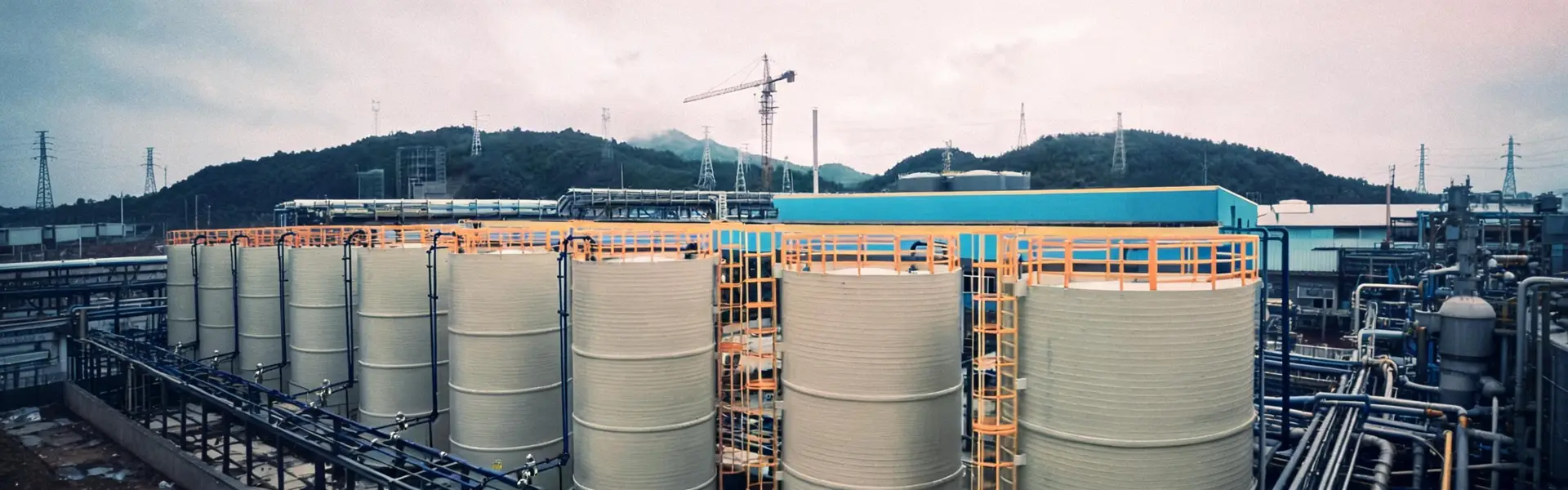
Projects Delivered
Countries Exported
Quote Response
Max Single-Run Height
Bulk Storage Applications
Grain Silo & Grain Bin Cage Ladder Options
Chemical tanks, grain silos and grain bins all need corrosion-resistant, engineer-verified access. We build the right cage ladder for each.
Chemical Tanks
Wall-mounted access for tank inspection and maintenance. SS304 or HDG with structural calcs for your tank height.
Grain Silos
Tall single-run cage ladders to silo roofs, with rest platforms for multi-run systems above 25 m.
Grain Bins
Rugged galvanized access for farm and processing grain bins, built to last in outdoor conditions.
Corrosion Protection
SS304 & Hot-Dip Galvanized – Corrosion Protection
Tank and silo ladders live outdoors and face chemicals, humidity and weather. Choose the corrosion protection that matches your site.
- SS304 for Chemical & Coastal
PMI-tested stainless for chemical, marine and food-grade environments
- HDG for General Outdoor
Q235B with HDG 85–100 μm per ISO 1461 – proven value for silos and bins
| Option | Best For | Finish |
|---|---|---|
| SS304/SS316 | Chemical, coastal, food | Acid-pickled, passivated |
| Hot-Dip Galvanized | General outdoor, silos | HDG ISO 1461 85–100 μm |
| Q345B (heavy duty) | Large tanks, high loads | HDG or painted |
Specifications
Bulk Storage Ladder Specifications
Engineered parameters for every chemical tank and grain silo cage ladder, made-to-order to your tank height.
| Specification | Value |
|---|---|
| Rung Diameter | Φ20 mm |
| Rung Spacing | 280 mm (≤300 mm) |
| Clear Width | 500 mm |
| Cage Diameter | Φ700 mm (hoops 40×5 @≤1500, straps 30×3) |
| Cage Start | 2.2 m above floor |
| Load Rating | 1.5 kN per rung |
| Entrance | Flared / flared splay entry |
| Standards | EN ISO 14122-4 · OSHA 1910.28 |
Structural Calcs & Compliance Documents
Structural Calcs & Compliance Documents
No guessing on tank-wall ladders. Every order ships with engineer-signed structural calculations and its compliance file.
- Structural Calculation Sheet
Engineer-signed for your tank, silo or bin height
- DoC – EN ISO 14122-4 & OSHA
Declaration of Conformity to the relevant standard
- MTC 3.1 Material Certificate
EN 10204 3.1 for Q235B / HDG / SS304
- Bulk Storage Project Backing
Petrochemical and agricultural projects delivered across 500+ projects in 50+ countries
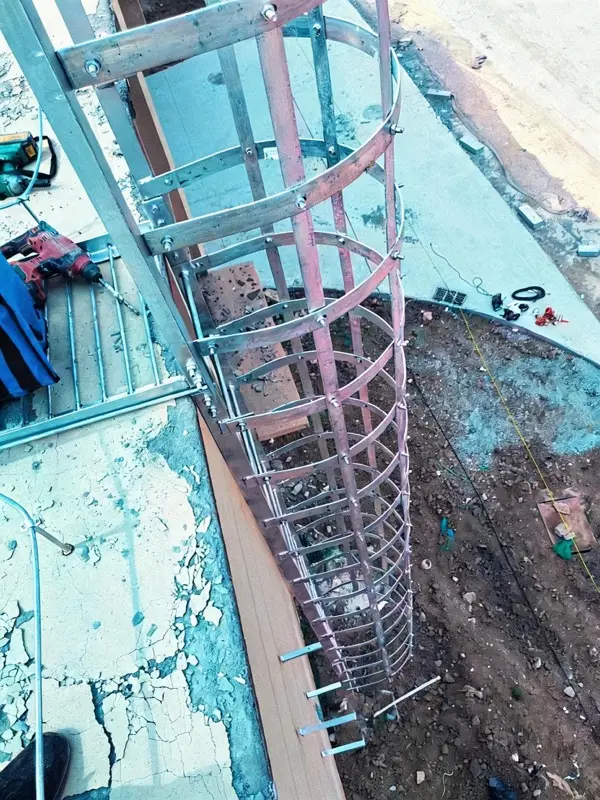
Get a Tank Ladder Quote
Get a Tank Ladder Quote
Tell us the tank, silo or bin type, height and material preference – our engineers reply within 24 hours with a drawing review, structural calc notes and a quote.
- 24h itemized quote
- Free structural calculation
- MTC, DoC & calcs included
The Three-Step Material Escalation for Chemical Zones
Chemical tank owners rarely need the most expensive ladder on the site — they need the right ladder for each zone. The bund wall and the far fence line can run galvanized steel, while the drip zone under a chlorinated header needs SS316. Escalating material only where the chemical actually reaches the steel is how plants stay inside budget.
Each step below keeps the same rung, hoop and strap geometry — only the steel and the price change.
Step 1 — HDG Q235B for the outer zones
General outdoor chemical parks and access routes away from drip zones. Hot-dip galvanized to ISO 1461 at 85–100 μm, from $95 per meter.
Step 2 — SS304 for splash and wash-down
Tanks with routine wash-down, milder product splashes and food-grade chemical storage. About 1.8x the galvanized price, with ISO 5817 Level C verified welds.
Step 3 — SS316 for chloride service
Chloride-bearing products, coastal plants and scrubber areas. About 2.5x the galvanized price, and the grade that stops pitting where others pit through.
Site Walkthrough
A Chemical Tank Ladder Inside the Turnaround Calendar
Priya is the turnaround planner for a specialty chemical site. Two acid storage tanks need ladder replacements inside a 14-day outage, and anything that touches the wrong service eats the schedule. Here is the project as it really runs.
Priya sends the service list for both tanks — acid class, vent stack positions, wash-down zones — plus shell heights, diameters, insulation cladding and the platform landing photos. The service list decides the metallurgy before anyone discusses price; chloride service points to SS316 immediately.
We plot each climb outside the vent plume and drip paths, then issue the GA drawing, SS316 bracket layout and calculation sheet. Every weld point is flagged for pickling and passivation so the heat tint does not become the first corrosion cell on site.
Because the runs arrive trial-fitted in single pieces up to 14 m, the crew spends outage hours on bolted saddles, not field welding permits. Cage hoops follow on the same bolted sequence, the gate closes off the platform edge, and the tank area clears hot-work paperwork entirely.
The site inspector checks rung spacing 280 mm, cage Φ700 from 2.2 m, weld inspection records to ISO 5817 Level C, and the EN 10204 3.1 MTC against the heat numbers. Photos from our five-stage QC close the file, archived for a decade.
| Survey Checklist (you bring) | Acceptance Checklist (you verify) |
|---|---|
| Chemical service list for each tank | SS316 MTC 3.1 heat numbers match the order |
| Vent stack and relief valve positions | Welds to ISO 5817 C, passivated and pickled |
| Shell height, diameter, insulation cladding | Rungs Φ20 at 280 mm, cage Φ700 from 2.2 m |
| Wash-down and hosedown zone map | Bracket torque matches the calculation sheet |
| Turnaround start and end dates | QC photo file and DoC in the handover pack |
Decision Guide
Chemical Tank Ladder Decisions: Choose This When…
On a chemical site the wrong metallurgy is not a maintenance issue — it is an incident report. These four forks are the ones our engineers settle before the quote goes out.
| Decision | Choose X when… | Choose Y when… |
|---|---|---|
| Metallurgy | SS304 (1.8x) — organic service, clean vapor zones, budget-driven projects away from chlorides | SS316 (2.5x) — chloride service, acid vents nearby, coastal salt or de-icing exposure on the climb line |
| Climb position | Opposite side from vents and relief stacks — the ladder ages at the structure rate, not the plume rate | Vent-side position with SS316 upgrade — when pipe racks leave no alternative climb corridor |
| Finish route | Pickled and passivated stainless — weld heat tint removed, corrosion cells never start | HDG Q235B at $95/m — utility tanks, fire-water and non-aggressive service where galvanizing outlives paint fivefold |
| Exit and gates | Walk-through exit at the platform with self-closing gate ($60–180) — gloved operators with sample kits top out safely | Side-step exit when nozzle spacing or a vapor collector blocks the direct landing |
The mistake that shows up as a corrosion audit finding
- The mistake: value-engineering the ladder to SS304 or HDG on a chloride-service tank because the quote for SS316 "looked high".
- The consequence: chloride stress cracking starts at the welds within a few turnaround cycles, the cage thins exactly where a falling operator loads it, and replacement happens as an emergency order in the next outage.
- The correct move: send the service list with the RFQ — we match the grade to the exposure in writing, quote SS316 at 2.5x with the calculation sheet free, and you compare real lifecycle costs, not just day-one prices.
What You Get
Chemical Service Features, Translated to Plant Outcomes
What each engineering line buys you between turnarounds.
| Feature | Advantage | Your Outcome |
|---|---|---|
| SS316 option at 2.5x HDG | chloride and acid vapor resistance | no corrosion-driven re-order in the asset life |
| Pickled and passivated welds | heat tint removed on every joint | corrosion audits pass without weld caveats |
| Trial-fitted one-piece lengths to 14 m | no field welding inside the unit | outage hours spent bolting, not permitting |
| Vapor-zone climb plotting | ladder sited away from vents and drips | inspection intervals measured in years |
| MTC 3.1 traceable heat numbers | every length of steel provable | management-of-change file closes in one pass |