 LadderCage
Grain Elevator & Hopper Access
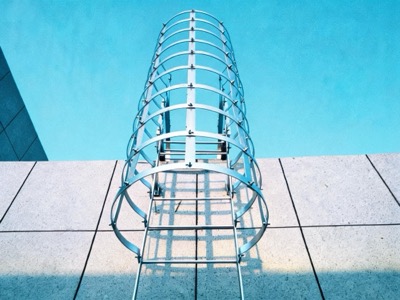
Grain Elevator Cage Ladder
Grain elevator & hopper cage ladders — hot-dip galvanized, built for dusty facilities, structural calcs with every order. EN ISO 14122-4 compliant.
Projects Delivered
Countries Exported
Max Single Run (spliced) · 14 m one-piece
Quote Response
Grain Elevator Cage Ladder Applications
Hopper Cage Ladder – Dusty Facility Access
Designed for the two access jobs that matter most in a grain plant — elevator maintenance and hopper inspection.
Grain Elevators
Safe maintenance access up grain elevator legs and head house ladders, caged to keep climbers contained on tall vertical runs.
Hoppers & Bins
Flared-entry cage ladders for hopper and bin inspection, with hot-dip galvanized surfaces that shrug off dust and condensation.
Built for Dusty Facilities
Hot-Dip Galvanized for Corrosion Resistance
Grain dust, humidity and condensation accelerate rust on plain steel. Hot-dip galvanizing to ISO 1461 gives grain elevator cage ladders decades of corrosion resistance.
- HDG 85–100 μm — dense zinc layer per ISO 1461
- Dust-friendly — smooth coated surfaces, easy to clean
- Outdoor-rated — same coating for silo-top and yard access
Specifications
Grain Elevator Ladder Specifications
Every grain elevator cage ladder is made-to-order with the engineered parameters below.
Get My Grain Elevator Quote| Specification | Value |
|---|---|
| Rung Diameter | Φ20 mm |
| Rung Spacing | 280 mm (≤300 mm) |
| Clear Width | 500 mm |
| Cage Diameter | Φ700 mm (hoops 40×5 @≤1500, straps 30×3) |
| Cage Start | 2.2 m above floor |
| Entrance | Flared / flared splay entry |
| Load Rating | 1.5 kN per rung |
| Finish | Hot-dip galvanized ISO 1461 85–100 μm |
| Standards | EN ISO 14122-4 · OSHA 1910.28 |
Compliance & Structural Verification
Structural Calcs & Compliance Documents
Full documentation with every grain elevator cage ladder — no chasing paperwork after delivery.
- Structural Calculation Sheet
Engineer-signed for project loads
- DoC — EN ISO 14122-4
Declaration of Conformity included
- MTC 3.1 Material Certificate
EN 10204 3.1 for Q235B steel
Get a Grain Elevator Ladder Quote
Get a Grain Elevator Ladder Quote
Tell us grain elevator or hopper, height and whether the facility is dusty — our engineers reply within 24 hours with a drawing review, structural calc notes and quote. Trusted on grain and silo projects across 500+ deliveries in 50+ countries.
- Grain & silo project experience
- 24h itemized quote
- Free structural calcs, DoC & MTC included
Mapping Ladder Access Across a Grain Elevator Complex
A country elevator is not one climbing problem — it is five. The headhouse demands the tallest caged run on site, the silo bank needs ladders that clear dust collectors, the dryer deck runs hot and humid, and the boot pit sits in the dust-heaviest air of the whole plant. Treating them with one ladder spec is how facilities end up with the wrong ladder at the worst location.
Here is how access is usually assigned, and what each point of the complex asks of the steel.
| Access Point | Typical Configuration | Environment Demand | Add-On |
|---|---|---|---|
| Headhouse | Tall caged run, rest platforms at 6 m intervals | Weather exposure, wind load on the tallest structure | Walk-through exit group, $90–250 |
| Silo bank exteriors | Caged runs on saddle brackets per shell diameter | Combustible dust settling on all surfaces | Non-sparking aluminum or SS contact parts |
| Dryer deck | Caged run with top landing platform | Heat and humidity around drying equipment | Self-closing gate, $60–180 |
| Gallery and conveyor runs | Caged access at transfer points | Dust zones along the belt line | Landing platform, $150–400 |
| Boot pit | Short caged or hand-railed ladder | Heaviest dust concentration below grade | Non-sparking materials specified here first |
Site Walkthrough
A Grain Elevator Ladder Project in the Off-Season Window
Elena runs safety for a country elevator with a 30 m headhouse and six storage silos. Combustible dust zones ring the bucket boots, so every hardware decision passes a dust lens first. Here is the project from her clipboard to the first inspection climb.
Elena marks the classified dust zones around the boots, legs and tripper floors on the site plan, then measures the headhouse climb, the silo roof hatch heights and the gallery runs between bins. Photos capture the leg casings and bearing greasing points the ladders must serve.
Our engineers split the design by zone: non-sparking aluminum or stainless climbing surfaces inside the dust envelope, hot-dip galvanized runs on the weather side. The GA drawing and calculation sheet show each boundary, and Elena's safety committee signs one revision.
Crews bolt trial-fitted modules — no cutting, no grinding inside the classified zones. The 6 m integral sections lift into place between train loads, cage hoops follow, and the self-closing gates land at the gallery and headhouse landings before the week ends.
The acceptance climb verifies rung spacing 280 mm, cage Φ700 from 2.2 m, and clean weld records to ISO 5817 C. Elena files the MTC 3.1, the DoC, and the factory photos — dust documentation the insurer asks for by name.
| Survey Checklist (you bring) | Acceptance Checklist (you verify) |
|---|---|
| Dust zone drawing with class boundaries | Non-sparking metals inside classified zones |
| Headhouse, silo and gallery climb heights | Rungs Φ20 at 280 mm, cage Φ700 from 2.2 m |
| Leg, boot and bearing service points | Gates self-close at every landing |
| Housekeeping and wash-down practices | No dust-collecting ledges on hoops or straps |
| Off-season window dates | MTC 3.1, DoC and QC photo file delivered |
Decision Guide
Grain Elevator Ladder Decisions: Choose This When…
Dust zones set the metal, structure height sets the run breaks, and the service calendar sets the schedule. Four forks decide the whole order.
| Decision | Choose X when… | Choose Y when… |
|---|---|---|
| Metal by zone | Aluminum or SS climbing surfaces — inside combustible dust envelopes where a spark is an ignition source | HDG Q235B at $95/m — outside the classified zone, weather-exposed silo walls and galleries |
| Run breaks | Single run (bolted splices) to 25 m, one-piece max 14 m — headhouse climbs and single silos with one crane day | Multi-run with rest platforms ($150–400) near every 6 m — 30 m legs and multi-silo galleries under EN ISO 14122-4 guidance |
| Top landing | Walk-through gallery exit with self-closing gate ($60–180) — operators top out inside guardrail | Sidestep exit onto silo roofs — when the hatch ring and vent layout block a straight landing |
| Scheduling | Off-season install — full crane access, empty bins, calm dust conditions | In-season modular swap — 6 m integral modules replaced one at a time while handling continues |
The mistake that walks a spark into a dust zone
- The mistake: ordering one all-galvanized ladder package and cutting it to fit on site inside the classified zone.
- The consequence: the angle grinder becomes an ignition source in a dust envelope, and even a near-miss puts the elevator into an insurance and OSHA review that outlasts harvest.
- The correct move: send the dust zone drawing with the RFQ — we deliver zone-matched metals and bolt-only, no-cut modules, with the calculation sheet free before you commit.
What You Get
Grain Elevator Features, Translated to Handling-Season Outcomes
What each design line earns you when the legs are running full.
| Feature | Advantage | Your Outcome |
|---|---|---|
| Zone-matched metals | non-sparking surfaces where dust lives | ignition risk engineered out, insurer satisfied |
| No-cut bolted modules | nothing ground or torched on site | install passes hot-work rules in the dust zone |
| Dust-shedding cage geometry | hoops and straps hold no grain ledges | housekeeping cycles stay short and cheap |
| 6 m replaceable modules | one damaged section reorders from MOQ 1 | a fork-truck strike never costs a whole run |
| Off-season scheduling discipline | 24 h quote, 15–25 day build to your window | crew climbs before the first truck of harvest |
Grain Elevator Cage Ladder FAQ
Related Pages
All Cage Ladders
Browse by type, material & application
Hot Dip Galvanized Cage Ladder
HDG ISO 1461 with zinc report
Cage Ladder Fall Protection
Requirements for tall access
Cage Ladder Height Requirements
When cages are required
Standards Hub
OSHA, EN ISO, BS, AS requirements
Get a Quote
24h itemized quote