 LadderCage
Factory-Direct Wall Mounted Cage Ladder
Wall Mounted Cage Ladder
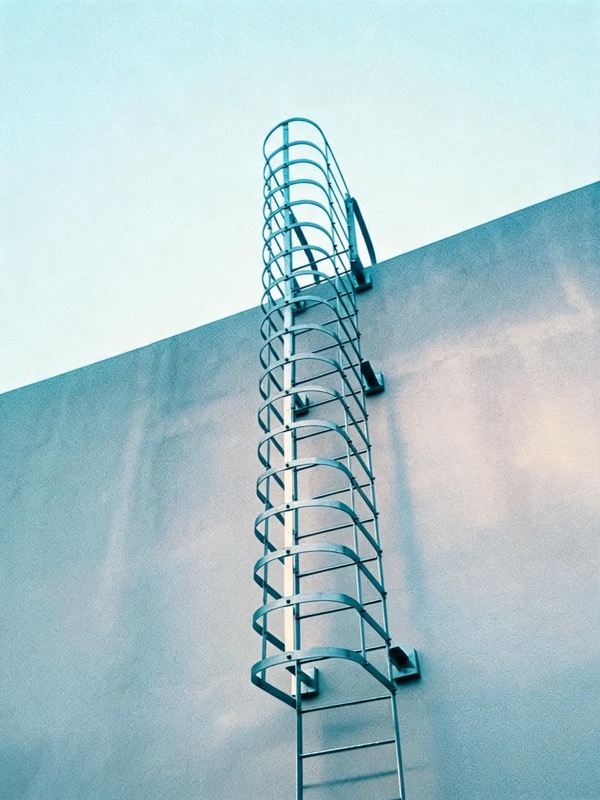
Wall mounted cage ladder – loose standoff brackets fit non-standard walls; OSHA 1910.28 & EN ISO 14122-4, DoC with order.
Projects Delivered
Countries Exported
Quote Response
Standoff Bracket
Standoff Brackets · Space-Saving · Any Height
Wall Mounted Ladder Cage – Standoff Brackets
Loose standoff brackets fit non-standard walls, save floor space and mount at any height.
Loose Standoff Brackets
200 mm standoff with 8 mm brackets @ 1800 — adapts to uneven or non-standard walls.
Space-Saving Wall Mount
Sits tight to the wall and frees up floor space versus freestanding units.
Any Height
Custom heights up to 25 m single-run; multi-run systems beyond that.
Non-Standard Wall Fit
Fit Non-Standard Walls
Loose standoff brackets (standoff 200 mm, brackets 8 mm @ 1800) let the wall mounted cage ladder fit uneven cladding and irregular surfaces.
Get My Wall Ladder Quote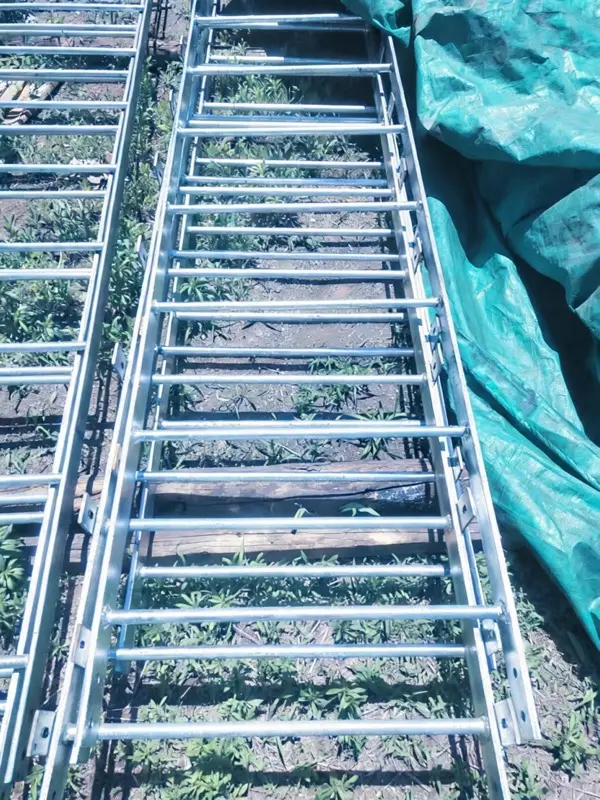
200 mm Standoff
Clearance for cladding, insulation and uneven surfaces.
8 mm Brackets @ 1800
Robust bracket spacing for a stable wall-mounted ladder.
Free Drawing Review
Engineer review of your wall fitting notes before production.
OSHA 1910.28 & EN ISO 14122-4
OSHA 1910.28 & EN ISO 14122-4 Compliance
Wall mounted cage ladders are built and documented to the relevant standard — DoC ships with every order.
- DoC — OSHA 1910.28 & EN ISO 14122-4
Declaration of Conformity to the relevant standard
- MTC 3.1 Material Certificate
EN 10204 3.1 for Q235B / SS304 / SS316
- Coating Thickness Report
HDG 85–100 μm per ISO 1461, measured per part
Specifications
Wall Ladder Specifications
Every wall mounted cage ladder is made-to-order with the engineered parameters below.
Get My Wall Ladder Quote| Specification | Value |
|---|---|
| Rung Diameter | Φ20 mm |
| Rung Spacing | 280 mm (≤300 mm) |
| Clear Width | 500 mm |
| Cage Diameter | Φ700 mm (hoops 40×5 @≤1500, straps 30×3) |
| Standoff | 200 mm (loose brackets) |
| Wall Brackets | 8 mm @ 1800 spacing |
| Cage Start | 2.2 m above floor |
| Standards | OSHA 1910.28 · EN ISO 14122-4 |
Get a Wall Mounted Ladder Quote
Get a Wall Mounted Ladder Quote
Free quote in 24 hours + free compliance kit with every order. Tell us your wall type and height — we'll confirm standoff and quote.
- 24h itemized quote
- Free wall fitting review
- DoC, MTC & coating report included
Field Story — Chemical Plant, Jubail
Hanging Nine Meters of Ladder on a Wall Nobody Wanted to Drill
An EPC engineer describes the rooftop access that had to climb a chemical storage building's facade — between a pipe rack and a cable tray, over a bund wall. The build card is that climb.
Before — roof access through the pipe rack, sort of
The tank-farm control room roof held the level transmitters and the HVAC for the instrument room, 9.1 m up. The only route ran through the adjacent pipe rack: a scaffold cage bolted to piping supports, signed off as temporary in 2019 and still there in 2026. Operations hated it, inspection flagged it, and every option on the ground was blocked — the bund wall on one side, a cable tray on the other, zero square meters to build anything freestanding.
During — engineering the wall side, not the floor side
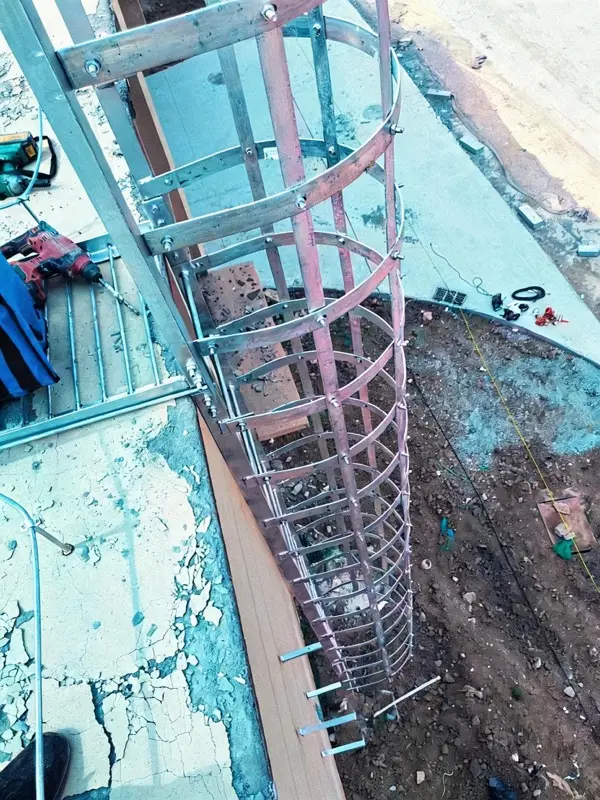
The facade was reinforced concrete — the one asset the site had in abundance. We drew the ladder on 200 mm standoffs at 1800 mm centres: enough clearance to clear the conduit run down the same wall, enough offset for drainage so the coating survives the chemical mist. Cage from 2.2 m, hoops Φ700 at 1500, HDG to ISO 1461 with the coating report in the file. The anchor plan went to the plant's civil engineer first — expansion anchors with pull-out values per bracket, sealed sleeves at every penetration, MTC 3.1 behind the DoC.
After — the scaffold cage came down
Transmitter work became a walk-to-the-wall task, and the pipe rack went back to being a pipe rack. Inspection closed the scaffold finding the same week the ladder went up. The standoff detail meant the wall membrane was touched at eight points, each sealed and logged — the facility engineer's only condition, met in writing.
| Build Card — 9.1 m Facade Climb | As Built | Why It Was Specified |
|---|---|---|
| Mounting | standoff 200 mm, brackets 8 mm @1800 centres | clears conduit, drains freely, protects the coating |
| Cage | Φ700 hoops @1500, from 2.2 m | containment the full climb over the bund |
| Anchors | expansion type, pull-out per bracket, sealed | civil engineer signed the plan before drilling |
| Finish | HDG 85–100 μm + report, ISO 1461 | industrial-atmosphere life budgeted at 10–20 years per ISO 14713 |
| Ground used | zero — wall carries everything | the site had none to give |
Where Does Your Ladder Hang?
Wall-Mounted vs Freestanding vs Tank-Shell Mounted
The same caged climb can hang off a wall, stand on its own frame, or ride the vessel it serves. The Jubail project went to the wall — here is the full trade, in decision order.
| Decision Factor | Wall-Mounted | Freestanding | Tank-Shell Mounted |
|---|---|---|---|
| Needs a sound structure | yes — wall takes every bracket load | no — frame carries itself | yes — shell must take saddle loads |
| Ground footprint | zero beyond the standoff | largest — frame plus foundation | none — rides the vessel |
| Cost posture | cheapest — no support steel | adds frame material and footings | moderate — saddles rolled to radius |
| Vibration and movement | fixed to a static structure | independent by design | must follow tank settlement and expansion |
| Membrane / coating risk | sealed penetrations at brackets | none on the wall | weld-free clips preserve shell integrity |
| Typical home | buildings, bunds, facade runs | yards, temporary structures, weak walls | tanks, silos, pressure vessels |
- Choose wall-mounted when a sound concrete, brick or steel wall exists along the climb line — it is the stiffest, cheapest, smallest-footprint answer.
- Choose freestanding when the wall cannot take the loads or does not exist where the climb must — pay the frame, save the structural survey.
- Choose tank-shell mounting when the climb serves the vessel itself — saddles share geometry with the shell and the access moves with the tank.
Feature → Advantage → Your Outcome
What Wall Mounting Buys You Over Any Alternative
Five lines from the facade drawing, translated into outcomes the plant still counts.
| Feature | Advantage | Your Outcome |
|---|---|---|
| 200 mm standoff @1800 centres | clears services, drains freely | conduit stays, coating lasts, wall breathes |
| Wall carries every load | no frame steel, no foundation | the cheapest climb per meter anywhere on site |
| Anchor plan with pull-out values | civil sign-off before drilling | no surprises in the concrete, no rework day |
| Sealed bracket penetrations | membrane warranty intact | eight logged points, not a wall of holes |
| HDG 85–100 μm + coating report | zinc measured for chemical-mist air | 10–20 year industrial life, on paper |