 LadderCage
Cage Ladder Standard PDF
Cage Ladder Standard Pdf
Cage ladder standard guide — OSHA 1910.23, ANSI A14.3, EN ISO 14122-4 and BS 4211 in one PDF. Free standard PDF with quote, plus update alerts.
Projects Delivered
Countries Exported
Standards in One PDF
Quote Response
Cage Ladder Standard PDF
Cage Ladder Standards Guide – One PDF
OSHA 1910.23, ANSI A14.3, EN ISO 14122-4 and BS 4211 — one quick-reference table, one downloadable PDF.
| Standard | Scope | Key Value |
|---|---|---|
| OSHA 1910.23 | US fixed ladders & fall protection | Ladder rungs 10–14 in (254–356 mm) |
| OSHA 1910.28 | US fixed ladder safety | Fall protection above 24 ft (7.3 m): LSS/PFAS on new ladders; existing cages grandfathered to 2036-11-18 |
| EN ISO 14122-4 | EU fixed ladders | Cage from 3.0 m, rung spacing 225–300 mm (our build starts hoops at 2.2 m) |
| BS 4211 | UK fixed ladder & cage | Permanently fixed ladder safety cage |
Free Standard PDF & Update Alerts
Free Standard PDF & Update Alerts
Stop re-reading four standards. Get the cage ladder standard guide as one free PDF with your quote, and opt in to rule change alerts when codes move.
- One PDF, four standards
OSHA, ANSI, EN ISO & BS in a single document
- Update alerts
Be notified when cage ladder standards change
- Free with quote
Sent with your itemized quote within 24 hours
Compliance Docs With Every Order
Compliance Docs With Every Order
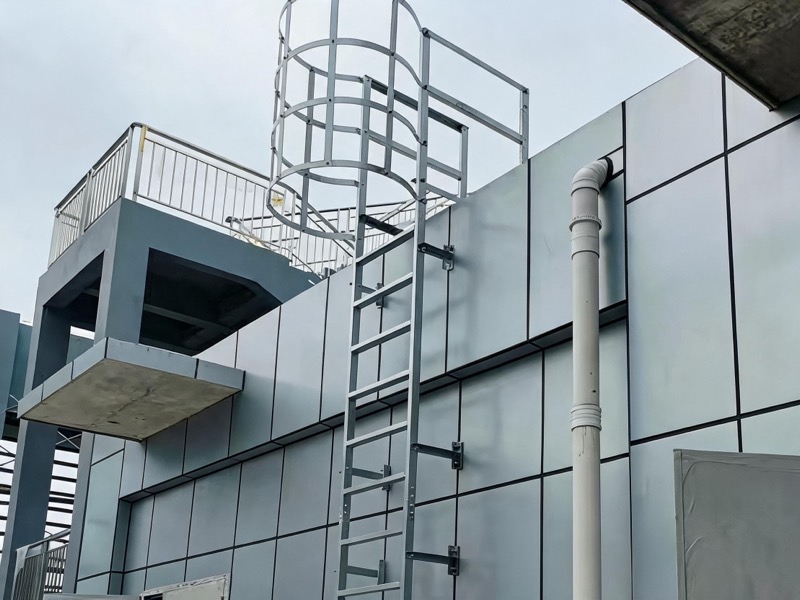
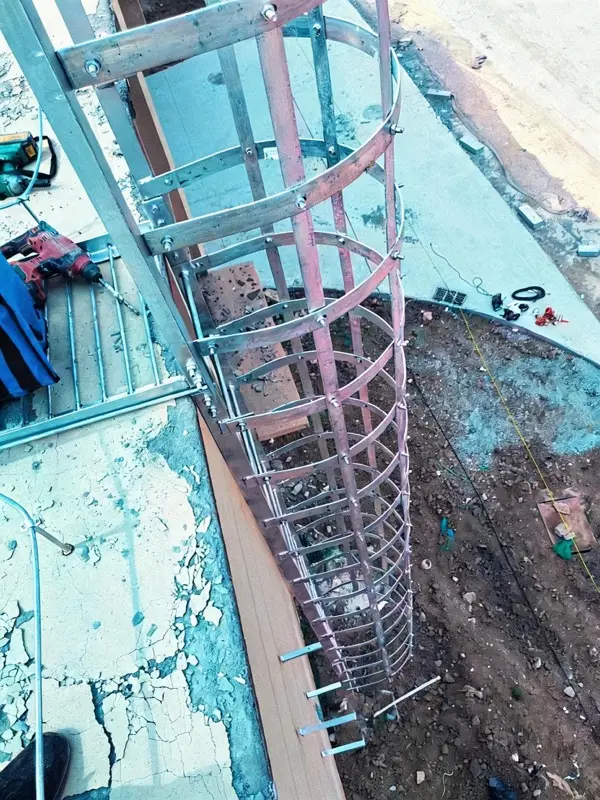
The standard PDF turns declarations into evidence. DoC and conformity statements ship with every order so your file is audit-ready.
- DoC & conformity statement
Shipped with every order, covering the standards you specify
- MTC 3.1
EN 10204 3.1 material certificates for Q235B / SS304
- Update-ready
Standard change alerts keep your file current
Product Specifications
Cage Ladder Standard PDF Quote
The quick-reference geometry behind the standard — every ladder is made to these engineered parameters.
| Specification | Value |
|---|---|
| Rung Diameter | Φ20 mm |
| Rung Spacing | 280 mm (≤300 mm) |
| Clear Width | 500 mm |
| Cage Diameter | Φ700 mm (hoops 40×5 @≤1500, straps 30×3) |
| Cage Start | 2.2 m above floor |
| Load Rating | 1.5 kN per rung |
| Finish | HDG 85–100 μm / SS304 |
| Standards | OSHA 1910.23 · ANSI A14.3 · EN ISO 14122-4 · BS 4211 |
One Ladder, Five Tape Measures
Five Inspectors, Five Different First Questions
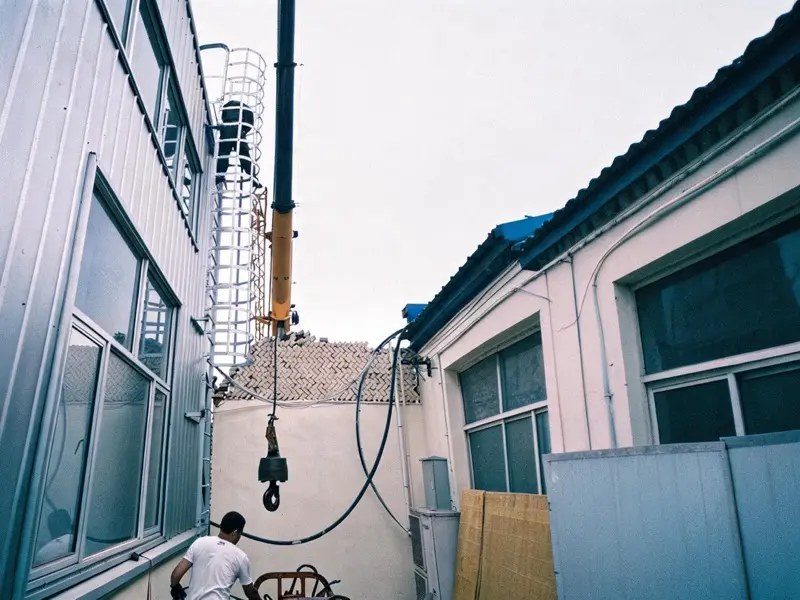
Standards feel abstract until you watch what each regime's inspector actually does at the same ladder. The US officer asks for the install date before touching the tape. The EU auditor counts flight lengths. The UK reviewer opens the rung load file. The Australian regulator asks the PCBU for evidence. The Singapore inspector measures between landings. One ladder that satisfies all five is not luck — it is a geometry chosen to sit inside every band at once.
| Inspector | First Measurement or Question | How One Build Answers All Five |
|---|---|---|
| US — OSHA compliance officer | height over 24 ft and install date against 19 Nov 2018; cage width 27–30 in, hoops within 6 ft 6 in | Φ700 mm cage centred on the climb line, hoops at 1500 mm, date-stamped QC photos |
| EU — EN ISO 14122-4 auditor | cage above 3 m, single flight capped at 6 m, rung band 225–300 mm | cage from 2.2 m, flight layout engineered to 6 m breaks, rungs at 280 mm |
| UK — BS 4211 reviewer | rung spacing 250–300 mm with 1.5 kN rating evidenced, basket 0.6–0.8 m | 280 mm rungs with the 1.5 kN load case in the engineer-signed calcs |
| Australia — WHS regulator | evidence the PCBU provided safe access; cage above a 3.0 m climb | DoC plus AS 1657 conformity statement in the handover folder |
| Singapore — MOM inspector | climbs over 9 m: successive landing places within 9 m | 6 m flights make every break a landing — 3 m of margin before the question |
Our standard geometry was not chosen to average the standards — it was chosen to sit inside all of them, so one drawing survives any of the five visits.
When the Standard Moves, What Moves With It?
Repair or Replace — Reading Standard Changes Correctly
Standard revisions trigger a reflexive question: does my existing ladder now fail? Almost never retroactively — but repairs, replacements and new installs each inherit different obligations. This table separates what a revision actually changes from what it only appears to change.
| Situation | The Rule That Decides | Our Supply |
|---|---|---|
| Existing ladder, standard reissued — geometry unchanged in practice | revisions do not retroactively condemn compliant assets; your DoC still names its edition | nothing — we re-issue a conformity statement to the current edition on request |
| Cage corroded, ladder sound | repair the protection, keep the asset — the cheapest compliant ladder is standing already | replacement cage modules to measured geometry, HDG to ISO 1461 |
| Repair cost passing half of new-build cost | sunk-cost repair loses on both money and the next inspection cycle | new unit from $95 per metre HDG with the full document set |
| US ladder over 24 ft reaching end of life | replacement = new installation — LSS or PFAS applies to the successor | rail-compatible ladder so the system mounts without a second project |
| Site changing jurisdiction (asset relocation) | the destination's standard governs, not the origin's | gap analysis against the destination standard before the move, in writing |
| Insurer or client demanding current-edition wording | contract language can exceed legal minimums — that is their right | DoC referencing the edition your counterparty names, clause by clause |
Send the ladder's age, condition and governing standard — the repair-or-replace line is drawn for you with numbers, inside 24 hours.
Feature — Advantage — Your Outcome
Standard-Proof Features on Every Build
Five features, each one aimed at a line in one of the five standards.
| Feature | Advantage | Your Outcome |
|---|---|---|
| Geometry inside all five bands | 280 mm rungs, Φ700 cage, hoops at 1500 mm | one build passes any inspector's tape |
| DoC naming the exact edition | 2016, 2018 or 2005+A1 — as your spec cites it | no version dispute at document review |
| Conformity statement per standard | clause-level compliance, standard by standard | multi-market fleets carry one coherent file |
| Flight layout engineered to 6 m | EN cap satisfied, Singapore 9 m rule cleared with margin | platform questions answered by the drawing |
| Free standards PDF with every quote | current versions in one file for your reviewers | tender answers cite editions, not folklore |
Get My Standard PDF
Get Your Standard PDF & Quote
Tell us your region and height — your standard PDF, update alerts and itemized quote are on the way within 24 hours.
- Free standard PDF with quote
- Update alerts on standards changes
- DoC & conformity statement included
Deep Dive — The Standards Map
Which Cage Ladder Standard Governs Where
Every cage ladder compliance question ends in one word: where. The destination determines the designated standard, and the designated standard determines the dimensions, the fall-protection triggers and the wording on the Declaration of Conformity. A ladder that is fully compliant in Houston can be rejected in Hamburg, and a Birmingham-spec basket can fail a Sydney inspection.
The map is stable but not static. The United States runs two layers — OSHA 1910.23 and 1910.28 as law, ANSI A14.3 as the consensus design standard — and is phasing cage-only designs off new tall ladders through dates running to 2036. Europe builds on EN ISO 14122-4:2016 with its 3 m cage trigger and 10 m ladder safety system rule. The UK adds BS 4211 with its 1.5 kN rung rating, Australia enforces through state WHS regulations with AS 1657 as the recognised path, and Singapore layers the WSH work-at-height regime over the references named in your specification.
Print the table, mark your destination, and the DoC writes itself.
| Destination | Designated Standard(s) | Signature Rules | Named on Your DoC |
|---|---|---|---|
| United States | OSHA 1910.23 / 1910.28 + ANSI A14.3 | 24 ft fall-protection trigger; 27–30 in cage width; hoops ≤ 6 ft 6 in; LSS on new tall ladders | OSHA duties + ANSI A14.3 where cited |
| European Union | EN ISO 14122-4:2016 | Cage above 3 m; flights ≤ 6 m; ladder safety system above 10 m; rungs 225–300 mm | EN ISO 14122-4:2016 |
| United Kingdom | BS 4211:2005+A1:2008 | Rungs 250–300 mm at 1.5 kN; hoops ≤ 1500 mm; basket 0.6–0.8 m | BS 4211 |
| Australia | AS 1657:2018 under state WHS regulations | Cage or alternative fall protection above 3.0 m climb | AS 1657:2018 |
| Singapore | WSH (Work at Heights) Regulations 2013 + named SS references | Landing places so successive landings never exceed 9 m apart on climbs over 9 m | Singapore WSH + cited references |
| Multi-destination fleets | Strictest dimension set per line item | One drawing set, dimension columns per standard | Separate DoC per line item |
The free standards PDF that accompanies every quote collects these references into one file, and the quick-reference table keeps the current versions in view — useful when a client questions whether your EN ISO citation reflects the 2016 consolidation or an older edition. Tell us the destination and the governing spec at quote stage, and the paperwork leaves the factory aligned with the site that will inspect it.