 LadderCage
Fixed vs Caged – Use Case, Cost, Compliance
Cage Ladder Vs Fixed Ladder
Fixed vs caged: use case, rules and pricing explained. Free selection guide for both types; DoC and compliance docs for either type.
Years Manufacturing
Export Countries
Projects Delivered
Quote Response
Cage Ladder Vs Fixed Ladder
Cage Ladder Vs Fixed Ladder – Use Case, Cost, Compliance
Both are fixed steel ladders. The difference is the safety cage — and that drives use case, cost and the compliance rules that apply.
| Comparison | Cage Ladder | Fixed Ladder (No Cage) |
|---|---|---|
| Use case | Access above ~12 ft where enclosure is required | Low, infrequent access where no enclosure is needed |
| Cost | Adds hoops, straps & flared entry | Lower per-meter cost |
| Compliance | Cage geometry per OSHA 1910.28 / EN ISO 14122-4 | Clearance rules, no cage geometry |
| Shipping volume | Compact — cage ships disassembled | Similar, straighter profile |
Use Case
Height and frequency decide: above roughly 12 ft (3.7 m) of regular climbing — check your code's actual trigger (3 m EN/AS, 24 ft OSHA) — a cage ladder is the standard choice.
Cost
A cage adds material and welding, so per-meter cost is higher — the gap narrows at factory-direct prices.
Compliance
Both follow OSHA 1910.28 and EN ISO 14122-4; cage geometry applies only to the caged type.
Platform Ladder vs Cage – Shipping Volume View
Platform Ladder vs Cage – Shipping Volume View
An exporter's perspective most comparisons miss: shipping volume. A platform ladder ships bulky and eats container space, while a cage ladder packs compact and flat.
- Cage Ships Compact
Hoops, straps and rungs nest for dense packing
- Platform Adds Volume
Pre-fabricated platforms take significantly more space
- Lower Freight Cost
Less volume per meter means lower landed cost
DoC & Compliance Docs for Either Type
Compliance – DoC for Either Type
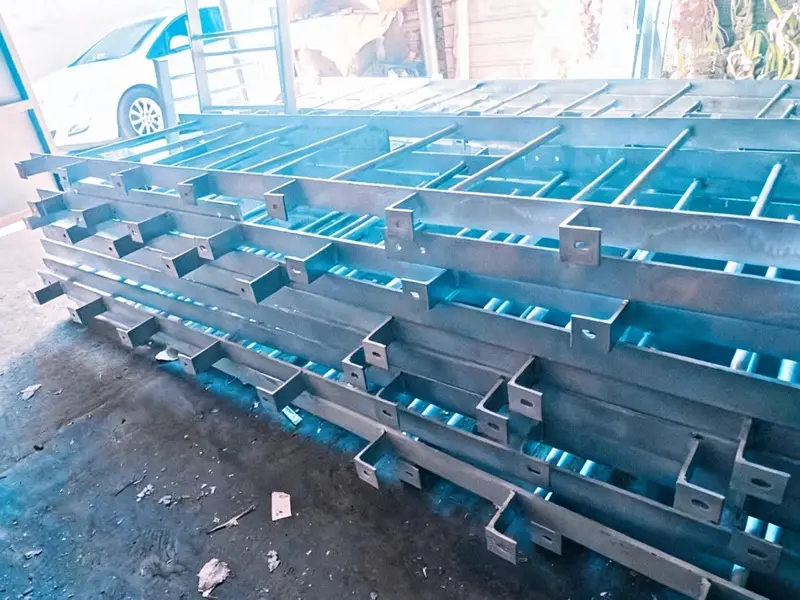
Whichever type you choose, the compliance file ships with it — DoC and documentation for a cage ladder or a plain fixed ladder.
- DoC for Either Type
Declaration of Conformity to OSHA / EN ISO
- MTC 3.1 Material Certificate
EN 10204 3.1 for steel supplied
- Structural Calculations
Engineer-signed for the ladder type supplied
Free Selection Guide for Both Types
Free Selection Guide for Both Types
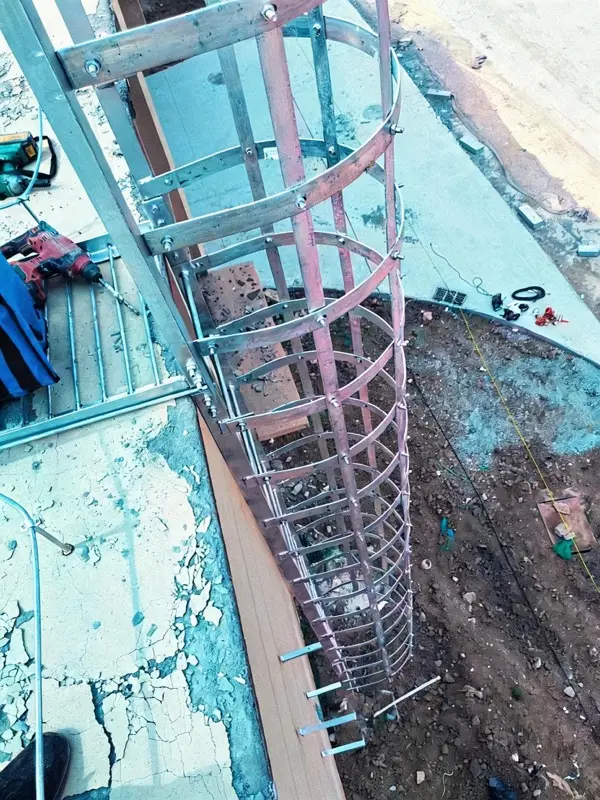
Get an objective guide covering both types — use case, cost and compliance compared — with a factory-direct quote.
Free Selection Guide
Both types compared on use case, cost and compliance, sent within 24 hours.
Compare & Quote
Quote either type at factory-direct price with a transparent cost breakdown.
Factory-Direct
Production in 15–25 working days, no distributor markup.
Get a Cage Ladder vs Fixed Ladder Quote
Get a Cage Ladder vs Fixed Ladder Quote
Tell us your application and height — we send the free selection guide with an objective recommendation and quote within 24 hours.
- Free selection guide for both types
- Use case, cost & compliance compared
- DoC for either type
Same Ladder, Two Builds
One Fixed Ladder, With and Without the Cage
The clearest way to see what a cage buys you is to hold every parameter constant and change one variable — the basket. Same rungs, same stringers, same anchors; the table shows what flips.
| Aspect | Uncaged Fixed Ladder | Same Ladder With Cage |
|---|---|---|
| Rungs and width | Φ20 mm @ 280 mm, 500 mm clear | Identical — nothing about the climb changes |
| Legal ceiling uncaged | Under 3 m (EN, AS) or 24 ft (OSHA general) | Compliant enclosure to the 10 m caged-system limit |
| Slip outcome | Climber falls clear of the rails | Backward fall restrained inside Φ700 hoops and 30×3 straps |
| Footprint | 500 mm on the wall | Adds the Φ700 cage envelope from 2.2 m upward |
| Inspection scope | Rungs and anchors | Adds hoops at 1500 mm, straps and welds to ISO 5817 Level C |
Give us the climb height and the code your site enforces — the free selection guide prices both builds of the same ladder within 24 hours.
Same Hardware, Three Rulebooks
The Comparison Experiment: One 8 m Caged Ladder, Audited Under Three Codes
The last table held the rule constant and changed the ladder. This experiment does the reverse: one identical 8 m caged ladder — Φ700 barrel, hoops 40×5 mm at 1500 mm, straps 30×3 mm, cage from 2.2 m, platforms at the 6 m mark — flown between three fictional sites, each enforcing a different code. Same steel, three verdicts. If your equipment travels between jurisdictions, or your corporate audit imports a foreign rulebook, this is the table to read twice.
| Audit Stop | The Rule in Force | What the Inspector Checks | Verdict on the Same Ladder |
|---|---|---|---|
| US plant, ladder in service before Nov 19, 2018 | OSHA 1910.28 grandfathering, current text | Cage condition, inspection log, the install-date record | Accepted — valid through Nov 18, 2036 while maintained; the 2025 proposal to drop the date is undecided |
| US plant, same ladder dated after Nov 19, 2018 | OSHA 1910.28(b) for new installations above 24 ft | Whether an LSS or PFAS accompanies the climb | Rejected as sole protection — the cage stays as restraint, the system line must be added |
| EN site in the EU | EN ISO 14122-4:2016 | Cage above 3 m, rest platforms at 6 m intervals, caged ceiling 10 m | Accepted — the 2.2 m start and the 6 m platform run inside every EN line |
| AS site in Australia | AS 1657:2018 | Cage trigger at 3 m, enclosure geometry | Accepted — the barrel dimensions match the code's expectation |
| UK practice | BS 4211 as the fabrication baseline | Rung, hoop and strap sections against the standard | Accepted — build values meet or exceed the fabrication clauses |
One ladder, one honest conclusion: the hardware rarely fails the audit — the paperwork and the date do. Tell us which stop your ladder faces and the free selection guide returns the exact build that passes it, both caged and uncaged variants priced, inside 24 hours.
Cage or No Cage on Your Wall
Reader Decision Guide: Ordering the Fixed Ladder With or Without the Cage
The uncaged fixed ladder is not the budget option — it is the correct option inside its envelope, and an expensive mistake outside it. Three climbs cover the decision space; find yours before the purchase order names the product.
Order plain fixed when the climb stays short
Your climb rises under 3 m on EN and AS sites, or under the OSHA line in US general industry, and lets out onto a guarded surface. The cage owes you nothing — order the open fixed ladder, spend the difference on base discipline and a marked entry. Buying the cage here adds steel, footprint and inspection scope without adding duty.
Order the cage when the climb crosses the line
Between 3 m and 10 m on EN and AS sites — or the US equivalent a cage satisfies — the enclosure is the duty, not the upgrade. The same ladder body costs $95 per metre in HDG with the cage doing what this page's table showed: turning a slip into a contained event. Platforms at $150–400 join at the 6 m mark.
Order neither alone when the rule names a system
A post-2018 US climb above 24 ft, or an EN climb beyond 10 m: the uncaged ladder is illegal and the caged ladder is insufficient — OSHA 1910.28 and EN ISO 14122-4 both point at the LSS or PFAS. Order the ladder as the carrier, the system as the protection, and let the cage tag along where it still adds restraint value.
One climb height decides the row — measure the rise, send it with your code, and the free selection guide prices the correct variant of both builds within 24 hours.
Both Builds, One Standard
What You Get Whether the Cage Is on the Order or Not
Five features held constant across both variants of the fixed ladder.
| Feature | Advantage | Your Outcome |
|---|---|---|
| Same rung and width spec either way | Φ20 mm at 280 mm, 500 mm clear, 1.5 kN per rung | the climb feels identical with or without the barrel |
| Both variants on one approval drawing | cage and uncaged elevations priced side by side | the cage decision made against visible numbers |
| Cage retrofit quoted from the same file | the uncaged build can gain its barrel later by design | today's budget decision stays tomorrow's option |
| DoC naming your code and variant | OSHA 1910.23, 1910.28 or EN ISO 14122-4 as ordered | each build passes its own audit stop in the table above |
| Free selection guide in 24 hours | both variants priced for your exact rise | the cheaper option is chosen with evidence, not hope |
Cage Ladder Vs Platform Ladder FAQ
Related Pages
All Cage Ladders
Browse by type, material & application
Cage Ladder Types
Galvanized, aluminum, stainless, FRP
Cage Vs Fall Protection System
Rules and upgrade path explained
Fixed Ladder With Cage
Fixed access with safety cage
Standards Hub
OSHA, EN ISO, BS, AS requirements
Get a Quote
24h itemized quote