 LadderCage
What Is a Cage Ladder?
Cage Ladder Definition
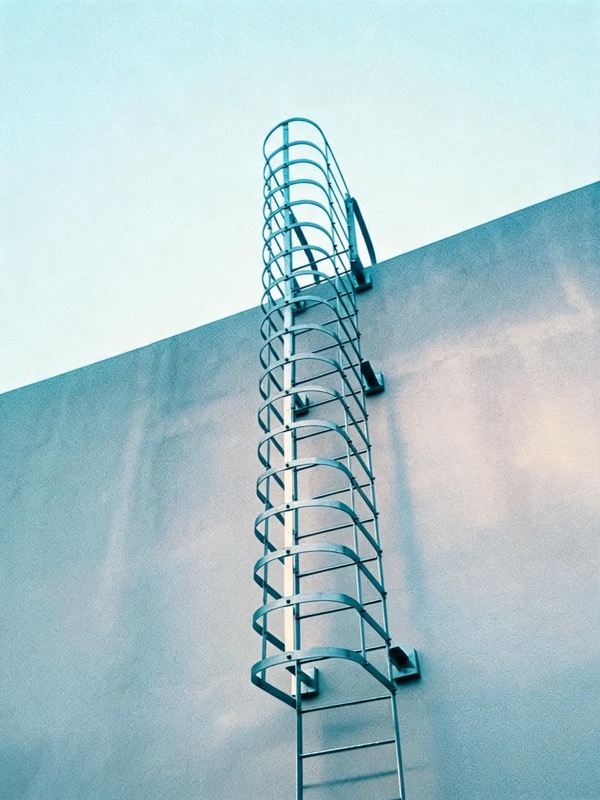
A cage ladder is a fixed ladder enclosed by a metal cage forming a tunnel. Free spec sheet and definition guide; quote within 24 hours.
Years Manufacturing
Export Countries
Projects Delivered
Quote Response
Cage Ladder Definition
Ladder Cage Meaning Explained
A cage ladder is a fixed ladder enclosed by a metal cage that forms a tunnel around the climber. The cage limits fall range and is commonly required on fixed access above certain heights.
- Fixed ladder — permanently mounted, vertical or near-vertical access.
- Metal cage tunnel — hoops and straps enclosing the climb path.
- Fall-range limiter — reduces injury if a climber slips, not a fall-arrest system.
Components & How It Works
Cage Ladder Components & How It Works
Rungs
Φ20 mm rungs spaced at 280 mm (10–14 in) for a comfortable, standard climb.
Hoops & Straps
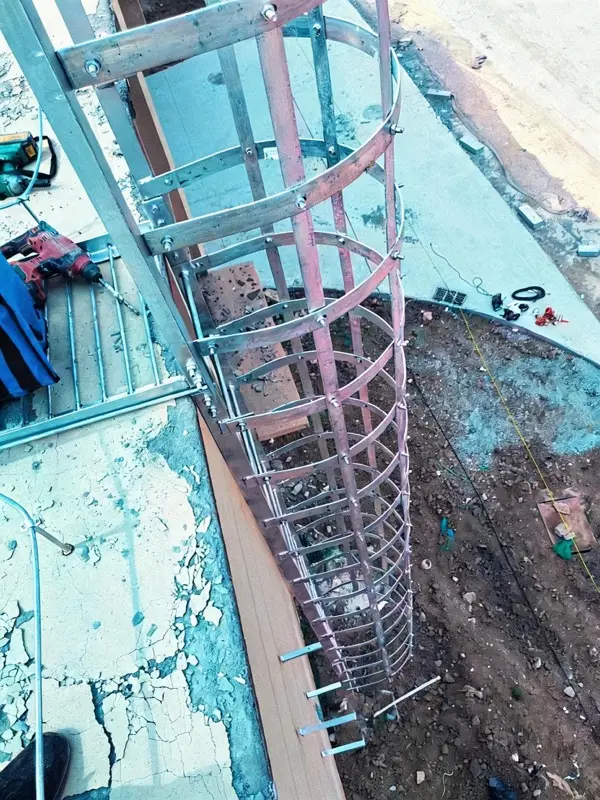
Φ700 mm hoops with vertical straps form the tunnel that limits fall range.
Flared Entry
The flared splay entry guides the climber safely into the cage from the platform.
Specifications
Cage Ladder Specifications
Every cage ladder is made-to-order with the engineered parameters below. HDG is standard; SS304 is available on request.
Get My Free Spec Sheet| Specification | Value |
|---|---|
| Rung Diameter | Φ20 mm |
| Rung Spacing | 280 mm (≤300 mm) |
| Clear Width | 500 mm |
| Cage Diameter | Φ700 mm (hoops 40×5 @≤1500, straps 30×3) |
| Cage Start | 2.2 m above floor |
| Load Rating | 1.5 kN per rung |
| Finish | HDG 85–100 μm per ISO 1461 / SS304 optional |
| Standards | OSHA 1910.28 · EN ISO 14122-4 · BS 4211 |
Compliance & Free Spec Sheet
Compliance & Free Spec Sheet (OSHA / EN ISO 14122-4)
Every cage ladder ships with its full compliance file — no chasing paperwork after delivery.
- DoC — OSHA 1910.28 & EN ISO 14122-4
Declaration of Conformity included
- MTC 3.1 Material Certificate
EN 10204 3.1 for Q235B / SS304
- Structural Calculation Sheet
Engineer-signed for project loads
Get a Free Spec Sheet
Get a Cage Ladder Spec Sheet & Quote
Free spec sheet and definition guide, plus an itemized quote within 24 hours. Tell us your application and height — we handle the rest.
- Free spec sheet & definition guide
- 24h itemized quote
- DoC, MTC & structural calcs included
Parts Anatomy
Every Part of a Cage Ladder, Explained
A cage ladder reads as one welded assembly, but each member carries a distinct engineering job. The table below breaks the definition into its components with the exact parameters we build to, so you can check any supplier quotation against the same anatomy.
| Part | Dengtai Build Spec | Function in the Definition |
|---|---|---|
| Rungs | Φ20 mm @ 280 mm centres | Climbing surface; each rated 1.5 kN so a booted worker never overloads a single step |
| Side stringers | Continuous steel rails | Carry the rungs and transfer the climb load into the building anchors |
| Cage hoops | 40×5 mm @ 1500 mm, Φ700 mm | Form the tunnel rings that keep the climber inside the cage envelope |
| Cage straps | 30×3 mm bars | Link the hoops so the basket — not one bar — arrests a backward fall |
| Cage start | 2.2 m above floor | Leaves headroom at the base while caging every metre that matters |
| Finish | HDG 85–100 μm per ISO 1461 | Corrosion package that keeps the definition intact for decades outdoors |
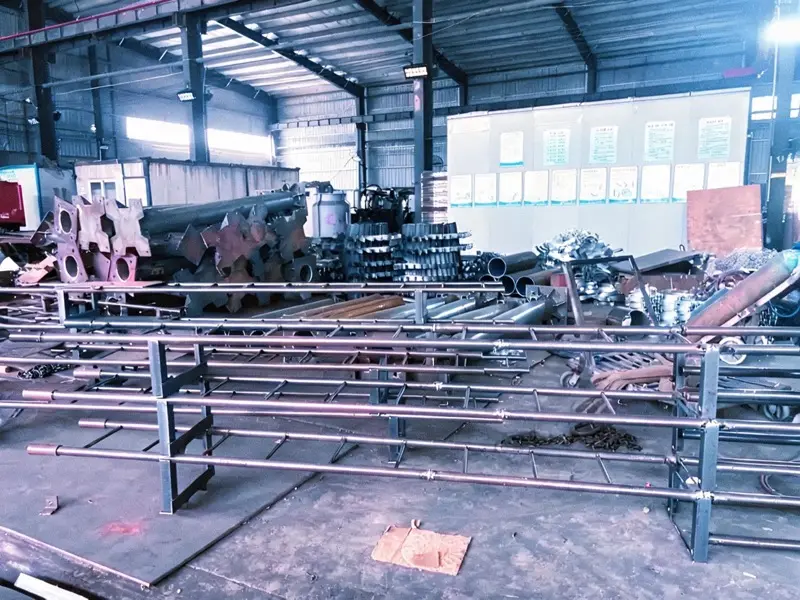
Welds joining these parts are inspected to ISO 5817 Level C, and every ladder passes a trial assembly before it leaves the Jingxing plant — the definition only counts when the parts hold together.
Anatomy Read as Defense
What Each Part Defends Against — and How It Fails When Neglected
A definition explains what the parts are. An inspection explains what they owe you: every member of a cage ladder stands guard against one specific failure, and every member has a neglect mode that switches that guard off. The table below reads the anatomy in that direction — part by part, the hazard it answers, and the exact way it lets you down when maintenance skips it. Use it as the checklist your annual inspection deserves.
| Part | The Hazard It Defends Against | Its Neglect Failure Mode | What Keeps It on Guard |
|---|---|---|---|
| Rungs, Φ20 mm at 280 mm | Foot slip and stride break — the tight pitch limits how far a boot can miss | Section loss at the weld ends turns a 1.5 kN step into an assumption | Annual hands-on check against the ISO 5817 Level C weld baseline |
| Side stringers | Load concentration — they spread the climb into the anchors instead of one point | Undetected impact damage or corrosion thins the rail where eyes rarely go | Visual line check full-height, both rails, every inspection cycle |
| Cage hoops, 40×5 mm at ≤1500 mm | Backward rotation — the rings carry the torso if the body swings out | A single flattened hoop opens a gap the straps cannot close alone | Ring roundness check; roundness is structural, not cosmetic |
| Cage straps, 30×3 mm | Free fall through the ring line — the lacing makes a wall, not a series of gaps | Missing or sprung straps return the basket to a row of separate rings | Count and continuity check against the drawing in the DoC file |
| Cage start at 2.2 m | Base-zone strikes — headroom stays open so entry never becomes an obstacle course | Stored material creeping under the ladder recreates the hazard by Tuesday | Housekeeping discipline — the cheapest row on this table |
| HDG finish, 85–100 μm per ISO 1461 | Corrosion — the coating is the corrosion budget for the whole assembly | Breached coating spends the budget early and quietly on every wet cycle | Coating checks on the same schedule as the weld check |
The definition holds only as long as every row holds — which is why our QC file photographs each part at trial assembly and archives the record for 10 years. Request the free spec sheet and both tables arrive together: what the parts are, and what they owe you.
Is This the Product You Need
Reader Decision Guide: When the Cage Ladder Is the Right Answer
Knowing the definition is step one; ordering one is a decision with alternatives. Before you put a cage ladder on the purchase order, run your project against the three situations below — one of them confirms the cage ladder, one of them redirects you, and one of them shrinks the specification to something cheaper than you planned.
Order the cage ladder when
The climb is fixed, routine and sits between 3 m and 10 m on EN or AS sites — or the US equivalent a cage still satisfies. Maintenance access to tanks, silos and roofs is exactly this duty: a defined path, used by trained adults, where passive containment beats gear logistics. At $95 per metre HDG, $600–900 covers a 6 m climb with the compliance file included.
Order something else when
The climb runs past 10 m under EN ISO 14122-4, or above 24 ft on a post-2018 US install where OSHA 1910.28 requires a system — there the answer is an LSS or PFAS, with the cage as a companion layer at most. At the other end, a sub-3 m climb owes no cage at all: an open fixed ladder and a clear base do the job for less.
Trim the specification when
The environment is inland and dry — SS304 at 1.8× and SS316 at 2.5× are answers to coastal and chemical air, not status. Most sites are served by Q235B hot-dip galvanized to ISO 1461 at 85–100 μm, and it outlives the equipment around it. Spend the difference on a walk-through exit and a self-closing gate where the climb lets out.
If your project sits between two of the cards, it is a five-minute conversation — send the climb height and the exit detail to sales@dtsteelladder.com and the engineers answer with the right specification, quoted, within 24 hours.
The Definition, Delivered
What Ordering From the Definition Writer Gets You
Five features, each one a row of the anatomy held to a number.
| Feature | Advantage | Your Outcome |
|---|---|---|
| Every anatomy value stated in writing | rung, hoop, strap and start-height numbers on the spec sheet | your order is checkable against the definition, clause by clause |
| EN 10204 3.1 MTC per batch | the steel in your ladder is the steel in the certificate | the definition stands on traceable material, not verbal grade |
| Welds inspected to ISO 5817 Level C | part-to-part joints verified at the factory | the anatomy holds together under load, with a record to prove it |
| Trial assembly before dispatch | the whole definition bolted together once before you see it | what arrives matches what was approved, or it does not ship |
| Free spec sheet in 24 hours | definition and build values on one page, no commitment | you compare suppliers against the same anatomy, not slogans |