 LadderCage
Cage Ladder Explained, Factory Direct
What Are Cage Ladders?
A cage ladder is a fixed ladder with a metal cage tunnel – learn what they do and why. Free cage ladder guide and factory-direct price list; OSHA & EN ISO 14122-4 compliant.
Projects Delivered
Countries Exported
Quote Response
Max Single Run
Definition
What Is The Purpose Of A Ladder Cage – The Tunnel Explained
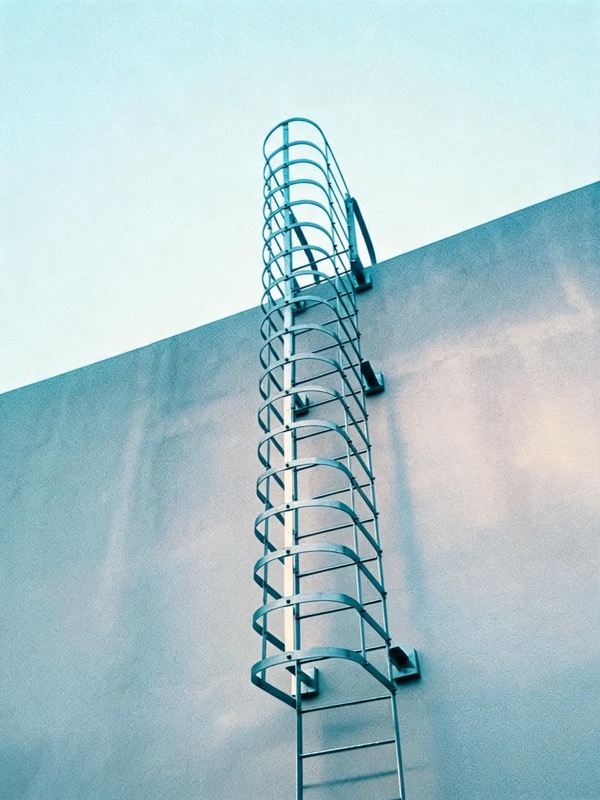
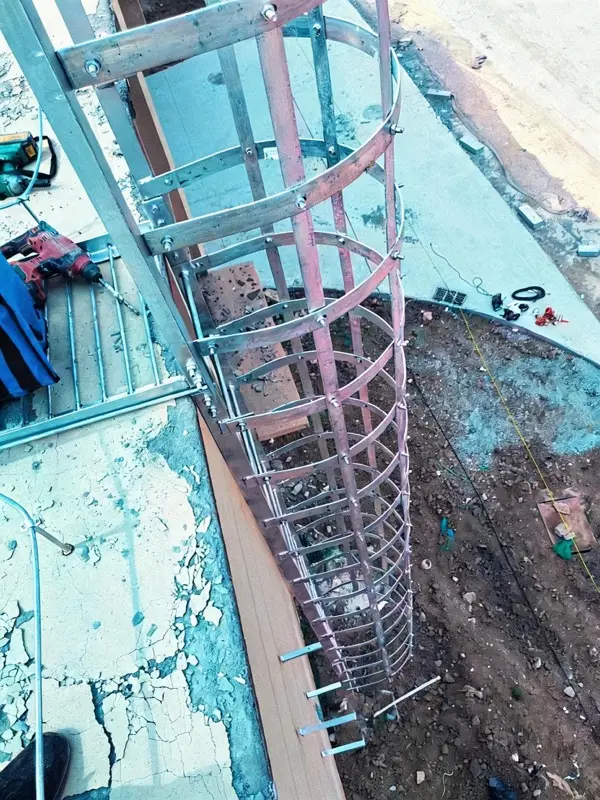
Think of a cage ladder as a fixed ladder wrapped in a metal tunnel. Hoops and vertical straps form the cage around the climbing path, so the climber is guided and contained from roughly 2.2 m above the floor to the top of the ladder.
- Fixed Ladder + Metal Cage Tunnel
The cage encloses the rungs, guiding the climber vertically
- Purpose: Fall-Enclosure, Not Fall-Arrest
Contains the climber within the climbing path; it does not stop a fall
- Built to Standard
Hoops 40×5 mm @1500, straps 30×3 mm, cage Φ700 mm per OSHA & EN ISO
Where They Are Used
What Does a Ladder Cage Do? – Use Cases
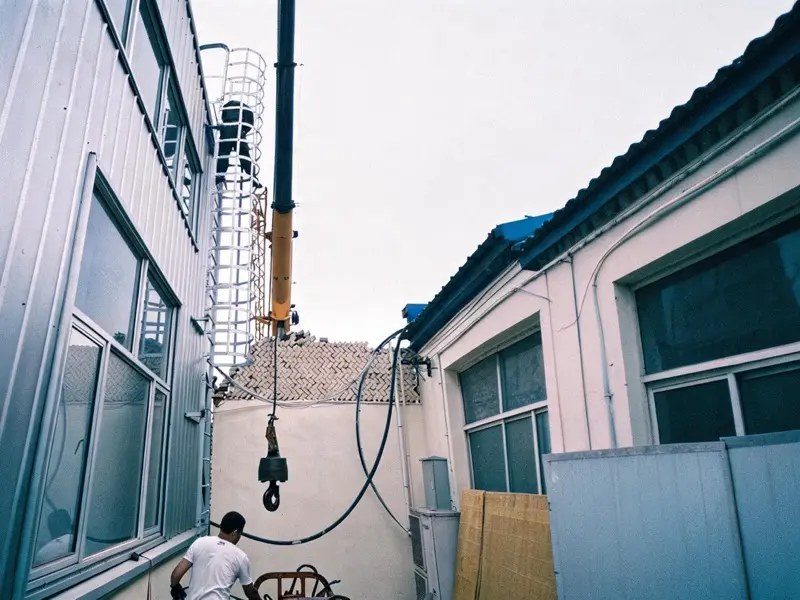
Cage ladders solve one problem everywhere: safe, confident vertical access to a raised level. Here are the common use cases.
Roof Access
Maintenance access to flat roofs, plant decks and building services.
Mezzanine Access
Raised storage and workstation access in warehouses and factories.
Storage Tank Access
Inspection and fill-level access on tanks, vessels and silos.
Chimney & Tower Access
Tall vertical routes up chimneys, stacks and towers.
Compliance & Documentation
OSHA & EN ISO 14122-4 Compliance
A cage ladder is only as useful as the standard it is built to. Every LadderCage.com cage ladder ships compliant, with the paperwork to prove it.
- OSHA 1910.28 & EN ISO 14122-4
Geometry engineered to the relevant standard for your region
- Docs & Specs With Every Order
DoC, MTC 3.1 and engineering specs ship with each ladder
- Cage + Docs + Custom Options
Choose a compliant cage ladder with full documentation and any custom height
Free Resources
Free Guide & Factory-Direct Price List
Get the cage ladder explainer guide plus a factory-direct price list — no obligation, and an itemized quote within 24 hours. Trusted across 500+ projects in 50+ countries.
Explainer Guide
Definitions, geometry and standards in one free download.
Factory Price List
Transparent, itemized pricing direct from the production floor.
24h Quote
No obligation — engineers reply within one working day.
Free Cage Ladder Guide
Get Your Free Cage Ladder Guide
Tell us your application and height — we send the guide and factory price list within 24 hours, plus a free drawing review if you are ready for a quote.
- Free explainer guide
- Factory-direct price list
- Docs & specs included
Choosing Vertical Access
Where Cage Ladders Fit Among The Access Options
Cage ladders are one answer on a spectrum of vertical access equipment. Specifiers pick between an open ladder, a caged ladder, a platform system or stairs based on climb height, frequency of use and budget — this table shows where the caged ladder wins, and where another option serves better.
| Access Option | Typical Use | Strength | Trade-off |
|---|---|---|---|
| Open fixed ladder | Short climbs below cage thresholds | Lowest cost, minimal footprint | No enclosure as height grows |
| Cage ladder | Maintenance access on tanks, silos, roofs | Contained climb at $95/m HDG, light structure | Hands still needed for the full climb |
| Multi-run caged system | Tall structures above single-flight limits | Rest platforms break the climb | More steel, more install days |
| Ship stairs or stairs | Frequent two-way traffic | Walkable, carries tools easily | FAR larger footprint and cost |
| Ladder with fall-arrest rail | Very tall or code-driven climbs | Personal protection the whole way | Harness training and recertification |
Most industrial sites end up with a mix — caged ladders for routine maintenance, stairs at busy points. Tell us the climb height and how often it is used, and our engineers will recommend the option that fits, quoted within 24 hours.
Find Your Variant in Four Questions
The Family Selector: Which Cage Ladder Are Cage Ladders in Your Case
What are cage ladders is really a family question — the collective covers every enclosure build from a 3 m silo hop to a platformed 10 m system in SS316. Instead of browsing the family, run your project through four questions in order. Each answer narrows the branch, and by the fourth you have named the exact variant your site needs — the one our engineers then quote as a line-itemed drawing rather than a description.
| Question | Your Answer | Branch It Selects | Variant So Far |
|---|---|---|---|
| 1 — How high is the climb? | 3–6 m, single flight | Geometry: one straight caged run, cage from 2.2 m | Single-flight caged ladder — $600–900 in HDG for a 6 m example |
| 1 continued | Over 6 m to the 10 m ceiling | Geometry: multi-run with a rest platform at each 6 m stage | Platformed caged system — platforms at $150–400 each |
| 2 — What is in the air? | Inland, dry, ordinary plant | Material: Q235B, hot-dip galvanized to ISO 1461 at 85–100 μm | HDG build at the $95 per metre baseline |
| 2 continued | Coastal, pool, chemical or marine splash | Material: SS304 for aggressive air, SS316 for the hardest duty | Stainless build at 1.8× or 2.5× the HDG baseline |
| 3 — Where does it let out? | Step-off onto a guarded surface | Exit: simple step-through above the last rung | Standard exit — nothing added to the order |
| 3 continued | Through a roof or platform opening | Exit: walk-through with a self-closing gate | Gated exit at $60–180 — the opening closes itself |
| 4 — Which rule governs? | EN ISO 14122-4 or AS 1657 | Check: cage above 3 m, platforms at 6 m, caged ceiling 10 m — variant confirmed | Your four answers, validated against the code before quoting |
| 4 continued | Post-Nov 2018 US install above 24 ft | Check: add the LSS or PFAS line — the cage stays as restraint only | Caged ladder plus system, quoted as one package |
Four questions, eight answers, one named variant — that is the whole catalogue collapsed into your project. Send the four answers through the quote form and the free selection sheet returns the variant as an itemized drawing inside 24 hours.
One Family, Three Buyers
Reader Decision Guide: What Cage Ladders Should Mean on Your Purchase Order
Buyers asking the plural question usually arrive in one of three roles, and each role should leave this page with a different next step — including the role whose correct answer is to buy fewer cage ladders than planned, not more.
The new-project specifier
You owe the drawing the family, not a preference. Run the four-question selector for every climb on the site and let the answers order the variants: single flights on the tanks, platformed systems on the silo, gated exits wherever an opening exists. Consolidating all of it into one order earns the volume tiers and one freight plan — one factory, one compliance file, every climb on site.
The fleet owner consolidating
Your move is standardization, not shopping. Mixed legacy access means mixed inspection findings; converging on one geometry — Φ700 cage, 40×5 hoops at 1500 mm, 30×3 straps, 2.2 m start — means one training, one checklist and one spare-parts logic across sites. Replace the worst bays first at $95 per metre HDG, and every subsequent bay quotes faster on drawings already held.
The cautious buyer under a rule
If your site sits under OSHA 1910.28 for a new climb above 24 ft, or your EN climb exceeds 10 m, cage ladders alone are the wrong purchase — order the family member the rule names: an LSS or PFAS, with the cage as the passive companion. Buying cages into that position wastes the budget and still fails the inspection. Confirm which rule governs before the purchase order, not after.
Whichever role you hold, the free guide and price list shows the whole family on one sheet — request it above and specify from evidence, within 24 hours.
The Family, Supplied as One System
What Each Capability Returns to Your Project
Five features covering every member of the family you might order.
| Feature | Advantage | Your Outcome |
|---|---|---|
| Full family from one factory | flights, platformed systems, gates in HDG or stainless | one vendor for every vertical climb on the site plan |
| Selector answered by an engineer | your four branch answers verified before quoting | the variant ordered is the variant the code wanted |
| Material ladder priced transparently | HDG baseline $95 per metre, SS304 at 1.8×, SS316 at 2.5× | environment decisions made against stated multipliers |
| Volume tiers across the whole order | every climb in one purchase counts toward the breaks | site-wide consolidation becomes a visible saving |
| Free family guide and price list | the full range on one sheet, no commitment | specification meetings run from paper, not memory |